
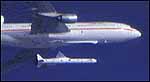
Orbital Imaging Corporation, the Earth imaging subsidiary of Orbital Sciences Corporation, announced today its OrbView-2 satellite successfully reached operational orbit and collected its first test images of Earth. OrbView-2 was launched August 1, 1997, aboard Orbital's Pegasus XL launch vehicle. Pegasus deployed the OrbView-2 spacecraft into a circular "parking' orbit of 310 kilometers. Over August, Orbimage conducted an extensive series of spacecraft tests and determined that the satellite's operating systems are performing well. During this same period, the Orbimage ground team successfully commanded the OrbView-2 spacecraft to raise its orbit to an altitude of 705 kilometers through a series of 32 separate firings of the satellite's onboard hydrazine thrusters.
Today, Orbimage successfully activated the SeaWiFS sensor carried by the OrbView-2 and collected test images of the United States and the Atlantic, and transmitted these images to the main satellite control and image processing center at Dulles, VA. With these milestones achieved, the OrbView-2 satellite is ready to commence its mission providing multi-spectral (color) images of the Earth's oceans and land surfaces for use in scientific and commercial applications. These applications include supporting the National Aeronautics and Space Administration's (NASA) Mission to Planet Earth initiative. NASA will use OrbView-2 imagery to better understand the Earth's carbon cycle processes and their effect on global warming trends. Commercially, Orbimage will market the multi-spectral imagery to organizations involved in environmental monitoring, alongw ith fisheries, forestry and agricultural applications.
During September, the onboard SeaWiFS instrument will continue to produce test imagery that will be introduced to commercial markets and the scientific community in early October.
