
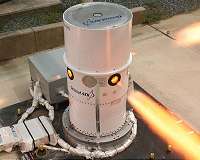
Engineers at Orbital ATK's facility in Elkton, Maryland, recently completed a successful test of the Orion Launch Abort System motor designed to steer the astronauts away to safety in the unlikely event of an emergency.
The Launch Abort System includes three motors, and the motor tested was the attitude control motor.
This motor consists of a solid propellant gas generator, with eight proportional valves equally spaced around the outside of the three-foot diameter motor.
Together, the valves can exert up to 7,000 pounds of steering force to the vehicle in any direction upon command from the Orion spacecraft and are designed to safely steer Orion after an ascent abort.
This is a critical safety enhancement of Orion for our journey to Mars. The test was a success thanks to the collaborative efforts of NASA, Lockheed Martin and Orbital ATK.
NASA Marks Progress on Hardware for Orion's Second Flight with Space Launch System Rocket
Machining for NASA's Orion spacecraft, scheduled to fly on the second integrated flight with agency's Space Launch System rocket, is well underway at Ingersoll Machine Tools in Rockford, Illinois.
The new deep space spacecraft will take humans farther into the solar system than we have ever traveled before.
The barrel of Orion's crew module, which arrived at the facility weighing about 12,000 pounds, will be reduced to approximately 880 pounds before it is shipped to NASA's Michoud Assembly Facility in New Orleans.
Four of the crew module's parts are being machined at Ingersoll before they ship for welding and assembly this summer.
The crew module is the part of the spacecraft where astronauts will live, work, exercise and eat during their missions beyond the moon.
12 Scientist-Astronaut Candidates Graduate at Embry-Riddle Through Project PoSSUM
12 new Scientist-Astronaut Candidates have graduated at Embry-Riddle Aeronautical University in Daytona Beach, Florida, as part of PoSSUM Class 1701 through Project PoSSUM, a non-profit research program devoted to the study of Earth's upper atmosphere.
PoSSUM, an acronym for Polar Suborbital Science in the Upper Mesosphere, uses research aircraft, high-altitude balloons, and commercial sub … read more
