
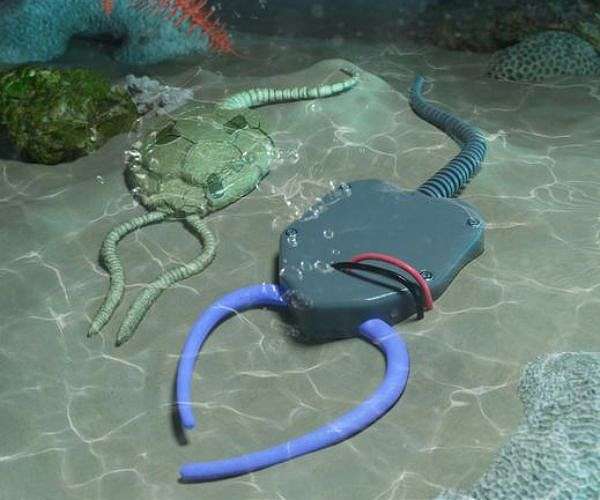
In the evolving field of soft robotics, researchers continually seek inspiration from a myriad of sources to push the boundaries of what these flexible machines can do. From medical devices to complex tasks in harsh environments, the adaptability and safety of soft robotics offer a promising avenue for technological advancement. One such innovative approach is being explored at Carnegie Mellon University, where Richard Desatnik, alongside a team of engineers and paleontologists from Europe, is delving into the ancient past to revolutionize the future of robotic design.
The team's work centers on the study of pleurocystitids, a type of ancient sea creature that thrived around 500 million years ago. These beings, related to modern-day sea stars and sea urchins, possessed a unique form of locomotion thanks to their muscular stem or tail. By examining fossils and employing CT scans to visualize the 3D structure of these creatures, Desatnik and his colleagues have embarked on a journey to recreate this ancient movement through soft robotics.
Desatnik shared the team's motivations, stating, "We've learned a lot from modern creatures, but that's only 1% of the animals that have existed during our planet's history. We want to see if there is something we can learn from the other 99% of creatures that once roamed the earth." This perspective underlines the vast untapped reservoir of biological strategies that have been honed over millennia but are yet to be explored in modern engineering.
Their research, which will be presented at the 68th Biophysical Society Annual Meeting in Philadelphia, Pennsylvania, has led to the development of a soft robot mimicking the pleurocystitids' movement. The team discovered that the sweeping motion of the creature's stem could have been a highly efficient means of gliding along the ocean floor. Intriguingly, they found that longer stems, which evolved in pleurocystitids over generations, could increase speed without significantly raising energy requirements.
The implications of this research extend far beyond academic interest. Desatnik envisions practical applications such as geological surveying and the maintenance of underwater machinery, highlighting the potential of underwater soft robots in improving efficiency and safety in these challenging environments.
This cross-disciplinary effort, dubbed paleobionics, not only sheds light on the evolutionary adaptations of ancient life forms but also paves the way for novel advancements in robotics. By looking back into the deep past, the researchers at Carnegie Mellon are contributing to a future where soft robotics can more seamlessly integrate into our world, whether it be in the depths of the ocean or the vastness of space.
The intersection of paleontology and robotic engineering exemplified by Desatnik's work underscores the limitless potential of interdisciplinary research. As the field of soft robotics continues to evolve, the lessons learned from the ancient inhabitants of our planet may well become a cornerstone in designing the next generation of robots, capable of navigating and performing tasks in ways that were previously unimaginable.
