
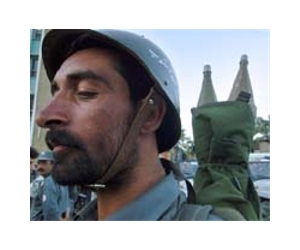
The Pentagon defended a program Monday that recruits local police forces in Afghan villages despite a US-funded report that raises questions about the militia's performance and alleged abuses.
Top officers, including the former commander of US and NATO forces in Afghanistan, General David Petraeus, have portrayed the Afghan Local Police initiative as a crucial tool in rolling back the Taliban in rural areas.
But the unpublished study commissioned by the Defense Department and prepared by the RAND Corporation think tank offers a less optimistic analysis, according to the Los Angeles Times, which obtained a copy of the report.
The study found that one in five US special operations teams advising the local police units said the Afghan militia had committed violence or abused civilians, and there were recent allegations of bribe taking, rape and drug trafficking, the newspaper said.
The RAND Corporation, which prepared the study, acknowledged quoted details from its report as accurate, but took issue with how the newspaper interpreted its assessment of security in villages where the local police operated.
The report said violence usually increased after US special forces entered an area to clear civilians, and then once the Americans withdrew with local police in place, the violence usually dropped back to the level seen before US forces arrived.
James Dobbins, director of the International Security and Defense Policy Center at RAND, called that trend an encouraging sign, because he said it meant villages in the restive east and south were approaching a lower level of violence in line with the country as a whole.
"For violence in the east and south of the country to drop to the national norm would in fact represent progress.
"It is therefore not a sign of failure that this seems to have been achieved over time in those areas where Afghan Local Police elements have been established but, quite the contrary, a sign of some success," Dobbins said in a statement.
Previous coalition programs to establish local police were scrapped before this latest attempt.
Designed to extend the reach of the Afghan army to rural areas, the local police are supposed to guard checkpoints, turn over suspected insurgents to regular troops and provide some intelligence on the Taliban.
The effectiveness of Afghan security forces, including the local police, holds the key to NATO's planned withdrawal of combat troops by the end of 2014.
US officials argue the Afghan forces are steadily improving, but it remains unclear how the army and police will perform once the bulk of the NATO force departs.
Afghan officials quoted by the Los Angeles Times said the local police were often under the grip of political power brokers and were tainted by criminal activity.
US defense officials said NATO-led forces were aware of cases of corruption or abuse, which they said were not unique to the local police, and that actions had been taken to remedy the problem in particular units.
But the officials, who spoke on condition of anonymity, said the overall effect of the local police was positive.
Pentagon spokesman George Little insisted the Afghan Local Police (ALP) program has proven effective and that Afghan security forces overall have made "tremendous progress" that he said has often been overlooked.
"We remain very committed to the ALP program," he told reporters.
"We realize they will continue to face challenges. They're on track, their capabilities are growing and we will continue to support them," he said.
Petraeus, the former chief of NATO-led forces who now leads the Central Intelligence Agency, has described the ALP as a "night watch with AK-47s".
As commander, he often cited the program as a success.
"In some cases, they have flipped' communities who once even actively supported the Taliban," Petraeus said in a 2010 article published by the Defense Department's official press service.
