
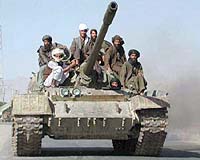
Reports that suggest the Taliban have gained a footing in Afghanistan's Kandahar province are "way overblown," a Pentagon spokesman said.
Press Secretary Geoff Morrell told reporters at a news conference that although an increased Taliban presence has been detected in the province, patrols conducted by Afghan National Police and coalition forces "found no evidence that militants control the area."
Press reports from the region said the Taliban had taken seven villages in the area and were poised for an attack on the city of Kandahar. "While in the area, coalition forces moved freely and met no resistance," Morrell said. "Recent reports of militant control in the area appear to be unfounded."
Traditionally, summer is the fighting season in Afghanistan, Morrell said, and this is precisely why Defense Secretary Robert M. Gates deployed 3,700 U.S. Marines to the area. In Regional Command South's area of operations, Marines are blunting an attempt by the Taliban to exert some control over that region.
The press secretary stated that no coalition official is worried that Kandahar is about to fall to the Taliban. "Quite to the contrary, they are confident that they have the forces necessary to secure RC South," Morrell said. "There are going to be attempts by the Taliban to put up some resistance."
In the wake of a prison break by hundreds of Taliban fighters over the weekend, NATO's International Security Assistance Force is moving a battalion to the area to deal with the aftermath. U.S. aviation assets are assisting the movement and are helping forces round up those who escaped, Morrell said.
Gates noted during a NATO defense ministers conference last week in Brussels, Belgium, that coalition deaths in Afghanistan exceeded those in Iraq for the month of May. Morrell said the secretary implored his fellow defense ministers to send more forces to Afghanistan.
"Afghanistan is the No. 1 priority for NATO, and yet we have to put our money where our mouths are to make sure we have adequate forces to do the job for that country," Morrell said.
Morrell also discussed an incident last week that allegedly resulted in the deaths of 11 Pakistani Frontier Corps soldiers. DoD officials said there has been an agreement in principle about the investigation, and that general officers from Pakistan, Afghanistan and the United States will cooperate.
"As we said last week, every indication we have still is that this was a legitimate attack by U.S. forces acting in self-defense," Morrell said. "All procedures and regulations and coordination had been followed."
Still, Gates said last week that if the investigation suggests the need for changes, U.S. officials will make them
earlier related report
Larger Force in Afghanistan 'Might Be Counterintuitive,' General Says
WASHINGTON, June 13, 2008 – The current number of forces in Afghanistan is enough to accomplish the mission, but it'll take awhile to do so, the U.S. officer who just finished his tour as commander of NATO troops in Afghanistan said here.
"Let's just say that somebody waved a magic wand, and by gosh, between the Afghans and the international force you'd produced a force that was well over 400,000," Army Gen. Dan K. McNeill said to reporters at a Pentagon news conference.
That larger force, McNeill said, likely would produce "instant quiet" across much of Afghanistan.
Yet, "in some areas you'd see a different kind of friction arising," McNeill predicted, as the Afghans probably would become incensed at having so many foreign troops in their land.
"So, probably, to get that many [troops] in there would be somewhat counterintuitive," the four-star general said.
McNeill, who recently wrapped up a 16-month duty tour in Afghanistan as commander of NATO's International Security Assistance Force, shared his experiences and thoughts about his prior command. He is preparing to retire from the Army after a 40-year career. Army Gen. David D. McKiernan assumed command of NATO's ISAF from McNeill.
The number 400,000 was obtained through a mathematical formula derived from U.S. counterinsurgency doctrine that factors in a country's landmass and population, McNeill explained. That force, he noted, would include diplomatic and reconstruction specialists, as well as U.S., NATO and Afghan security forces.
The aim of a counterinsurgency operation, McNeill pointed out, is to defeat the enemy's strategy by separating the people from the insurgents.
"You need reconstruction, you need the right kind of governance," in addition to security forces during counterinsurgency operations, McNeill pointed out.
Everyone acknowledges that anti-insurgent forces in Afghanistan are under-resourced, McNeill said. And there's little chance, he noted, that those forces would be greatly increased.
"The answer is, we've got the get the Afghans enabled" to conduct their own security, McNeill said.
It's important, McNeill said, to contemplate the state of the wills of the U.S. and European governments, as well as the Afghan people, to see the fight against insurgents in Afghanistan through to the end.
However, if there are going to be terrorist sanctuaries just out of reach of NATO or Afghan forces, McNeill said, then it doesn't matter how many terrorists are destroyed in Afghanistan.
"And, so it seems to me, at some juncture, the Afghans have to take on the responsibility for security of their own battle space," McNeill said. The Afghans, he noted, "are well on their way to doing that."
It'll take a few years for the Afghans to be ready to provide for their own security, McNeill predicted, noting Afghan forces will start taking over some of the battle space in their country around August.
The United States, its NATO allies and the Afghans accomplish the job with an under-resourced force structure, McNeill told reporters.
"It will simply take longer," he explained. "If you want a faster rate of progress, you need a more capable force. If you're not willing to make the force more capable, then you have to accept the pace that you presently have, which by some people's reckoning is somewhat slow."
