
After reading this article, you might never look at trash bags the same way again. We all use plastic trash bags; they're so common that we hardly give them a second thought. So who would have guessed that a lowly trash bag might hold the key to sending humans to Mars?
Most household trash bags are made of a polymer called polyethylene. Variants of that molecule turn out to be excellent at shielding the most dangerous forms of space radiation. Scientists have long known this. The trouble has been trying to build a spaceship out of the flimsy stuff.
But now NASA scientists have invented a groundbreaking, polyethylene-based material called RXF1 that's even stronger and lighter than aluminum.
"This new material is a first in the sense that it combines superior structural properties with superior shielding properties," says Nasser Barghouty, Project Scientist for NASA's Space Radiation Shielding Project at the Marshall Space Flight Center.
To Mars in a plastic spaceship? As daft as it may sound, it could be the safest way to go.
Less is more
Protecting astronauts from deep-space radiation is a major unsolved problem. Consider a manned mission to Mars: The round-trip could last as long as 30 months, and would require leaving the protective bubble of Earth's magnetic field. Some scientists believe that materials such as aluminum, which provide adequate shielding in Earth orbit or for short trips to the Moon, would be inadequate for the trip to Mars.
Barghouty is one of the skeptics: "Going to Mars now with an aluminum spaceship is undoable," he believes.
Plastic is an appealing alternative: Compared to aluminum, polyethylene is 50% better at shielding solar flares and 15% better for cosmic rays.
The advantage of plastic-like materials is that they produce far less "secondary radiation" than heavier materials like aluminum or lead. Secondary radiation comes from the shielding material itself. When particles of space radiation smash into atoms within the shield, they trigger tiny nuclear reactions.
Those reactions produce a shower of nuclear byproducts – neutrons and other particles – that enter the spacecraft. It's a bit like trying to protect yourself from a flying bowling ball by erecting a wall of pins. You avoid the ball but get pelted by pins. "Secondaries" can be worse for astronauts' health than the original space radiation!
Ironically, heavier elements like lead, which people often assume to be the best radiation shielding, produce much more secondary radiation than lighter elements like carbon and hydrogen. That's why polyethylene makes good shielding: it is composed entirely of lightweight carbon and hydrogen atoms, which minimizes secondaries.
These lighter elements can't completely stop space radiation. But they can fragment the incoming radiation particles, greatly reducing the harmful effects.
Imagine hiding behind a chain-link fence to protect yourself in a snowball fight: You'll still get some snow on you as tiny bits of snowball burst through the fence, but you won't feel the sting of a direct hit from a hard-packed whopper. Polyethylene is like that chain link fence.
"That's what we can do. Fragmenting – without producing a lot of secondary radiation – is actually where the battle is won or lost," Barghouty says.
Made to order
Despite their shielding power, ordinary trash bags obviously won't do for building a spaceship. So Barghouty and his colleagues have been trying to beef-up polyethylene for aerospace work.
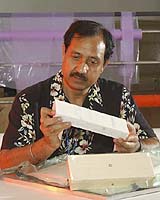
That's how Shielding Project researcher Raj Kaul, working together with Barghouty, came to invent RXF1. RXF1 is remarkably strong and light: it has 3 times the tensile strength of aluminum, yet is 2.6 times lighter – impressive even by aerospace standards.
"Since it is a ballistic shield, it also deflects micrometeorites," says Kaul, who had previously worked with similar materials in developing helicopter armor. "Since it's a fabric, it can be draped around molds and shaped into specific spacecraft components." And because it's derived from polyethylene, it's an excellent radiation shield as well.
The specifics of how RXF1 is made are secret because a patent on the material is pending.
Strength is only one of the traits that the walls of a spaceship must have, Barghouty notes. Flammability and temperature tolerance are also important: It doesn't matter how strong a spaceship's walls are if they melt in direct sunlight or catch fire easily. Pure polyethylene is very flammable. More work is needed to customize RXF1 even further to make it flame and temperature resistant as well, Barghouty says.
The Bottom Line
