
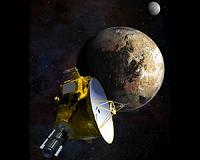
About a year ago the New horizons spacecraft, funded by NASA and built by the Applied Physics Lab of Johns Hopkins University, completed its 9 0.5-year flight from Earth to the now dwarf planet, Pluto. New Horizons has proven to be the "little spacecraft that could." It has travelled some three billion miles in order to capture the first detailed Pluto images and close-up science data.
Before New Horizons, the best image of Pluto was only a small dot. That all changed, officially, at 7:49 a.m. eastern time on July 14, 2015, when the probe made its pass by Pluto within 7,750 miles. Imagine a trip that took over nine years in order to fly past a small planet-like body for only a few minutes. At the moment of this passage the spacecraft's speed was 31,000 miles per hour. Since it had no way to slow down, it whizzed right by.
Amazingly, the first photos of Pluto at closest approach took another day to be received on Earth. Since the probe has only a small radioisotope thermoelectric generator (RTG) it can only transmit data at a very low rate. In addition, every data bit had to travel to Earth, some three billion miles away. This means that each data bit takes about 4.5 hours, at the speed of light, to make the trip back to Earth.
Why is Pluto so interesting? Pluto is the largest and second-most massive known dwarf planet in the Solar System. It is found in the Kuiper belt, a ring of trans-Neptunian objects, and the ninth-largest and tenth-most-massive known object directly orbiting the Sun. Pluto is primarily made of ice and rock and is relatively small compared to earth.
In terms of size, if you think of Earth as a basketball, Pluto would be a golf ball. It has about one-sixth our Moon's mass. This dwarf planet circles the Sun in an eccentric orbit at an average distance of 39.3 AU. Sunlight takes about 5.5 hours to reach Pluto at this distance.
Pluto was discovered in 1930 by Clyde Tombaugh, and had been known as the ninth planet in the Solar System. However, its status as a planet was questioned in the 1990s, after the discovery of several objects of similar size in the Kuiper belt. In 2005, Eris, an object more massive than Pluto, was discovered.
As a result the International Astronomical Union (IAU) formally defined the term "planet" for the first time in 2006, after New Horizons was launched. This new definition of a planet excluded Pluto, and it was reclassified as a member of the new "dwarf planet" category.
Strangely, even though Pluto is now a dwarf planet, it has five known moons: Charon, Styx, Nix, Kerberos and Hydra. The largest of these is Charon which has a diameter about half that of Pluto. Thus, Pluto and Charon are sometimes considered a binary system because the barycenter of their orbits does not lie within either body.
Earlier this year a summary of New Horizons' mission scientific findings were reported. The dwarf planet's surface was age-dated. One resulting conclusion was that Pluto has been geologically active throughout the past 4 billion years. In addition, the massive ice plain that is larger than Texas and is informally-named Sputnik Planum is devoid of any detectable craters. It has an estimated age of no more than 10 million years. However, the distribution of compositional units on Pluto's surface has been found to be extremely complex.
The composition of Pluto's atmosphere has been measured for the first time. In addition, a possible mechanism for forming atmospheric haze layers has been identified. Prior to the 2015 flyby, Pluto's four moons raised concerns about debris hazards among the several bodies. However, the onboard dust counting instrument counted only a single dust particle within five days of the flyby. This density level is similar to that generally found in the outer solar system, thus, eliminating the debris concern.
Charged-particle instruments onboard New Horizons detected the interaction region between the solar wind and Pluto's atmosphere to be confined to the dayside of Pluto to within only 6 Pluto radii, or about 4,500 miles.
Finally, scientists have concluded that the small bodies in the general Kuiper Belt population were not captured from the general Kuiper Belt population, but were formed as a result of a giant collision that created the entire Pluto satellite system. The science is fascinating and the implications are still being developed.
