
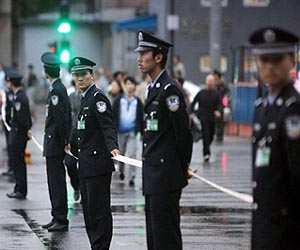
Villagers tossed petrol bombs in a clash with police in southern China that left up to 10 injured, the latest in a rash of violent incidents linked to land disputes, state press reports said Thursday.
Up to 40 rioters in Guangdong province, fearing eviction, clashed Tuesday with more than 100 police officers who responded with non-lethal "riot guns" and tear gas, said the Qingyuan Daily, a Guangdong newspaper.
It said police had arrived in the township to arrest a local man surnamed Huang suspected of storing petrol to make bombs.
Tensions were high as the local Yangshan county government had sought for years to evict 108 families from their homes to make way for a "public project", but locals have refused, complaining of insufficient compensation, the Global Times said.
The reports did not specify what sort of project was planned.
"Huang and others suspecting that the police were there to evict them and demolish their homes, incited the crowd into a confrontation with the police," the Qingyuan Daily report said.
One policeman and a villager were injured in the hour-long battle that left two police cars destroyed and seven other vehicles damaged, it said.
However, the Global Times said at least 10 villagers were injured in the clashes, some when police fired "riot guns" into the crowd and others when police threw a tear gas grenade into a home.
Reports described the guns as non-lethal weapons used to suppress violent crowds but gave no further specifics. No arrests had been made so far, according to the reports.
The Yangshan government and police refused to comment on the incident when contacted by AFP Thursday. But the press reports were posted on the local government website, suggesting it sanctioned those accounts.
China has seen a rash of violent clashes over land, many sparked by forced evictions as officials and property developers seek to cash in on a soaring real estate market.
Last week, police in neighbouring Guangxi province shot and wounded at least five demonstrators in clashes over a land dispute that also left 11 law enforcement officers injured, state media reports and a local official said.
On January 7, one person was killed and scores injured when police clashed with villagers in eastern China's Jiangsu province after up to 100 thugs — allegedly hired by a local government — tried to forcefully evict farmers from their land, residents and a Hong Kong-based rights group confirmed.
earlier related report
China jails former Tiananmen democracy leader: lawyer
Beijing (AFP) Jan 21, 2010 –
A former leader of the Tiananmen pro-democracy protests has been jailed for nine years for fraud, after authorities in Hong Kong handed him over to China, his lawyer and a rights group said Thursday.
Zhou Yongjun, a student leader of the 1989 demonstrations that were ended by a bloody army crackdown, was also fined 80,000 yuan (11,700 dollars) by a county court in the southwest province of Sichuan, his lawyer Chen Zerui told AFP.
"The judge only read out the sentence — we are still awaiting the formal written verdict," Chen said.
"We will appeal," he added, refusing any further comment on the case, other than expressing the hope that either Zhou's conviction would be overturned or his sentence reduced on appeal.
Zhou was arrested in Hong Kong in September 2008 and handed over to Chinese police in a case that brought into question the "high degree of autonomy" that Beijing promised the city upon its 1997 handover from Britain.
According to the Hong Kong-based Information Centre for Human Rights and Democracy, Zhou has been in and out of China since serving two years in prison following the Tiananmen crackdown.
After fleeing to the United States, he returned to China in 1998. He was rearrested and sentenced without trial to three years of hard labour.
Upon his release, he again fled to the United States, it said.
When arrested in Hong Kong, Zhou was carrying a fake passport and had allegedly tried to receive funds from Hong Kong's Hang Seng Bank under the name given on the false document, the Centre said.
His fraud conviction stems from the attempted transaction, it said.
During the trial, Zhou denied the charge against him, saying he had been the victim of bad luck and mistaken identity, the centre said.
At the time of his arrest in Hong Kong, Zhou had been planning to return to the mainland to visit his ailing father in Sichuan, it said.
Hong Kong was returned to Chinese rule in 1997 with the promise of a high degree of autonomy that included a separate judicial system.
Critics say Zhou's case has brought into question that promise, and noted that the case should have been tried in Hong Kong where the crime allegedly took place.
Share This Article With Planet Earth
