
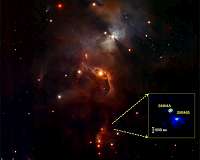
Babies grow up fast in the blink of an eye and thus their parents wish to record their growth without missing any moment. This is true not only for human babies but also for baby stars, called protostars, although the recorders are not parents but astronomers in this case.
Protostars' ages, or evolutionary stages, have been determined from observations at near- and mid-infrared wavelengths. The youngest stage, called Class 0, is defined by non-detection at these wavelengths, corresponding to <300,000 years old.
This definition cannot differentiate younger and older Class 0 protostars. On the other hand, it is expected from studies on even older protostars that they grow up faster at earlier stages than at later stages, as human babies do, implying that many precious moments of their growth are missed.
As we all know, human "babies" (fetuses) in mothers' wombs also grow at a fast rate – just as the star babies do. Using ultrasound scanning techniques, parents can hear the baby's heart beating during the regular prenatal examinations; not only so, they could even detect how much the thigh bone grows, how much the head circumference is, or perhaps, getting some hints about girl or boy! All of these are important indicators informing us about how much progress our babies are making – in terms of their growth.
Similarly, in order to record the important evolutionary stages of baby stars, rather than ultrasound scanners, astronomers would use millimeter/submillimeter telescopes. To probe the fast growth of Class 0 protostars, an international team led by Dr. Yusuke Aso of Academia Sinica Institute of Astronomy and Astrophysics (ASIAA, Taiwan) has observed three Class 0 protostars using the Atacama Large Millimeter/submillimeter Array (ALMA) and has differentiated evolutionary stages of those protostars in multiple aspects.
Thanks to ALMA's strong capabilities, the team revealed four evolutionary indicators in details: (1) dusty disk growth on 100 astronomical unit scales, (2) widening of outflow opening angles, (3) carbon-monoxide (CO) desorption from icy grains due to temperature rising, and (4) weakening of accretion shock, all of which are consistent with theoretical predictions for young protostars.
Their work demonstrates the importance of millimeter wavelength on probing young protostars' evolution. The work was also accomplished by ALMA's high spatial resolution differentiating morphology on the small scale and its high sensitivity detecting the faint molecular line from the cold regions.
The lead author Dr. Aso says: "From now on, the precious moments of young baby stars' fast growth will be recorded more precisely on millimeter wavelength."
