
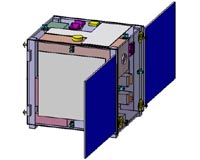
Proba-3 is the third in ESA's series of missions for validating developments in space systems while carrying an 'added value' user payload which can directly benefit from the innovations under test.
roba-3 will demonstrate the technologies required for formation flying of multiple spacecraft. An instrument to observe the solar corona is being used for the ongoing design phase.
During the ESA Council at Ministerial Level held in December 2005, new activities were proposed to cover the design, development and in-flight operation of a set of small satellites for the full-scale testing and validation of formation flying missions.
Formation flying technologies will make new types of missions possible and provide a leap in the performance of future science, Earth observation and application missions.
Mastering formation flying missions requires the development of specific technologies well beyond the present state-of-the-art in fields such as metrology and spacecraft guidance, navigation, and control.
Proba-3, currently in its preparatory study phase, will comprise two independent, three-axis stabilised spacecraft flying close to one another with the ability to accurately control the attitude and separation of the two craft.
Utilising either cold-gas or electrical thrusters for agile manoeuvring, and both radio-frequency and optical (laser-based) metrology techniques for accurate position measurement and control, the combined system is expected to achieve a relative positioning accuracy of the order of 100 microns over a separation range of 25 to 250 metres.
Other Proba spacecraft
