
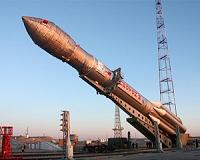
The interdepartmental state commission investigating the recent Proton-M carrier rocket launch failure has so far found no evidence supporting the theory that it was caused by deliberate misconduct, Russia's space agency Roscosmos said Thursday.
"The human factor version, including the possibility of a deliberate violation of production norms, is considered during an investigation into every accident or incident, it's a standard procedure. The commission has no information to prove it," Roscosmos said in a statement.
The commission still views technical failures in the third stage control engine as the most likely cause of the May 16 crash, in which Russia's most technologically advanced satellite was lost, the statement said.
On Thursday, the head of the government commission investigating the Proton crash, Alexander Danilyuk, said he believed a third stage engine glitch was at fault, while not ruling out that the failure occurred because of sabotage.
Last week, Danilyuk said four causes of the Proton-M accident were being considered. The commission quickly excluded a failure in the rocket's control systems.
Russian Deputy Prime Minister Dmitry Rogozin on Thursday criticized investigators for creating troubled waters too soon with half-baked theories.
The Proton-M rocket suffered an unknown failure and was lost May 16, about nine minutes after being launched from the Baikonur space center in Kazakhstan. The upper stage and its payload, the advanced Express-AM4R communications satellite, burned up in the atmosphere above China, with no debris reaching Earth.
The Express-AM4R satellite was manufactured by Astrium, an aerospace subsidiary of the European Aeronautic Defense and Space Company (EADS), and was built as part of Russia's space program for 2006-2015. The crashed rocket was insured for 7.8 billion rubles ($224 million). A replacement for the spacecraft will be built in three years time, the Ministry of Communications and Mass Media said.
Sabotage considered in Proton rocket crash – investigator
Moscow (Voice of Russia) May 30, 2014
The botched launch of the Proton-M rocket this month may have been caused by sabotage, the chair of the investigating commission said. This conspiratorial version is being considered as part of the probe, although it's not a likely scenario.
"All variants are being analyzed in detail. As of today the most likely version involves the failure of a bearing unit in the turbine pump assembly. But, I repeat, all versions are under consideration," Aleksandr Danilyuk, who chairs an inter-body commission investigating the May-16 incident, said.
"The sabotage version has not been ruled out," he added.
The Proton-M rocket, carrying Russia's most powerful telecommunication satellite, burned up after failing to enter orbit, when the third stage of the vehicle malfunctioned. It was the second attempt to put a satellite of this design into space.
This month's Proton crash is one of several similar incidents on record, including the July 2013 disaster, in which a rocket failed immediately after takeoff, rammed into the ground and erupted in an enormous ball of fire.
The sabotage version voiced on Thursday caused some hype in Russian media and drew a rebuke from Vice Prime Minister Dmitry Rogozin, who supervises the Russian space industry.
"The Roscosmos disaster commission should first finish its work and present the results to the Russian government, and only then torment society with new versions of what happened," he tweeted.
Earlier, the Russian national space agency indicated that the Proton launch failure was caused by a malfunctioning steering engine in the third stage. The fuel pump mentioned by Danilyuk provided the feed to the failed engine.
The commission is also considering a rupture in the fuel line, a failure of the fuel flow regulator due to fuel contamination and a clogged fuel filter as possible scenarios for the malfunction.
