
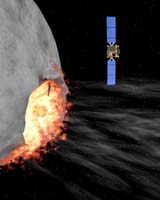
A consortium led by British aerospace company QinetiQ has won a 450,000 Euro contract from ESA to design a satellite mission that could be used to deflect an asteroid threatening Earth.
ESA will assess the resulting mission design proposals from the QinetiQ team, as well as from two other consortia awarded similar contracts, before selecting the preferred design in early 2007, the space agency said in a statement.
ESA expects to award further contracts to build and execute the mission, known as Don Quijote, which will visit a near-Earth asteroid – whose orbit does not represent a danger to Earth – to demonstrate the viability of the deflection concept.
The probability of a large asteroid impact with Earth in the near future is thought to be very low, but the consequence of such an impact would be potentially catastrophic.
Asteroids sometimes pass uncomfortably close to Earth. For example, a 500 meter (1,625 foot) diameter asteroid known as 99942 Apophis – which weighs nearly 1 billion tons – is expected to pass within 30,000 kilometers (18,600 miles) of Earth in 2029.
Astronomers think this will be the first time in human history such a large object has passed close enough to Earth to be seen with the naked eye. Also, 99942 Apophis became the first asteroid to register 2 on the Torino scale, which is used to measure the risk of an asteroid impact.
ESA has been addressing the asteroid problem for some time. In 1996, the Council of Europe called for ESA to take action and contribute to a "long-term global strategy for remedies against possible impacts."
Recommendations from other international organizations, including the United Nations, followed. In response, ESA commissioned a number of threat evaluation and mission studies. This preliminary phase was completed in July 2004 when a panel of experts recommended pursuing the Don Quijote asteroid-deflection concept.
QinetiQ's team will design their Don Quijote mission based on this selected concept. The mission will involve the use of two spacecraft. The first, an orbiter called Sancho, will orbit the target asteroid, measuring its position, shape, mass and gravity field with great accuracy over several months.
The second, an impactor spacecraft called Hidalgo, will then slam into the asteroid at a relative speed of 36,000 kilometers (22,500 miles) per hour. Sancho will image the impact and continue to monitor the asteroid's position in order to determine the deflection caused by the impact.
The QinetiQ consortium includes the Swedish Space Corporation, Verhaert Space, The Open University and SciSys. QinetiQ recently completed the design phase, as well as payload and electric propulsion work for ESA's Eddington and BepiColombo missions, as well as developing the SIMONE concept for a multi-satellite mission to rendezvous with multiple near Earth objects.
Verhaert's mission experience includes the PROBA program and the ESA Rendezvous and Docking Mission, in partnership with SSC.
SSC's small satellite programs include SMART-1 and ASTRID.
SciSys employs experts in ground systems, software architectures, autonomy, functional engineering simulation and visualization and have been involved in many ESA science missions.
