
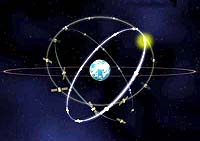
Exploiting "quantum weirdness" would dramatically improve the precision of radar, sonar, the global positioning system (GPS) and other object locators, MIT researchers report.
Seth Lloyd, associate professor of mechanical engineering, and Vittorio Giovannetti and Lorenzo Maccone, postdoctoral associates in MIT's Research Laboratory of Electronics, propose in the July 24th issue of Nature that taking advantage of the quirky nature of certain quantum pulses would create a significantly more accurate object locator. "We call this method QPS, a quantum positioning system," Lloyd said.
While QPS is unlikely to supplant GPS in the near future, as techniques for generating certain quantum pulses improve, quantum positioning systems are likely to come into play where high-accuracy, low-power applications are important, such as for satellite positioning, the researchers say.
Found In Space
Radar; sonar; lidar, a device similar to radar that emits pulsed laser light instead of microwaves; and the GPS use clock synchronization for locating objects in space and time.
That is, these techniques determine where things are at a particular time by sending pulses of light or sound from one place to another and back again. They then determine the arrival time of the pulses at the reference point.
The precision with which objects can be located depends on the accuracy with which the arrival time of the pulses can be determined.
"Our work shows that by exploiting 'quantum weirdness' one can in principle dramatically enhance the precision of such pulse-timing methods," Lloyd said.
"Counterintuitive features of quantum mechanics such as entanglement — quantum correlations that are 'excessive,' or greater than classical, and squeezing — the reduction of quantum noise levels below their semiclassical limit — can be employed to overcome the classical limits in these procedures."
Time Of Arrival
