
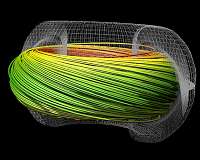
Plasma, the ionised state of matter found in stars, is still not fully understood, largely due to its instability. Astrophysicists have long-since sought to develop models that can account for the turbulent motions inside plasma, based on observing line shapes emitted by atoms and ions in the plasma.
Turbulences are typically detected through the observation of broadened lines due to the Doppler effect, similar to the principle behind radar. In a new study published in EPJ D, Roland Stamm from the CNRS and Aix-Marseille University, France, and colleagues develop an iterative simulation model that accurately predicts, for the first time, the changes to the line shape in the presence of strong plasma turbulence.
Ultimately, the authors aim to provide a system for assessing plasma turbulence that is valid for both a stellar atmosphere and the ITER tokamak designed to generate fusion energy. Line shapes are extensively employed as a powerful diagnostic tool for detecting turbulences in stable gases and plasmas.
For many years now, astrophysicists have developed and employed models that gauge the effect of turbulent motions in the broadening of line shapes due to the Doppler effect. Such models are now also being employed to understand the role of turbulences in plasmas created to harvest energy from fusion.
In this study, the authors review the effects of strong turbulence on the line shapes when the plasma is subjected to an external energy source, such as a beam of charged particles. Their model accounts for the effect of an electric field on a hydrogen atom subjected to strong turbulence within a plasma.
They subsequently perform numerical simulations for various low-density plasmas, ultimately determining that the width of the hydrogen line increases in the presence of strong turbulence connected to the external energy source, shaped as a sequence of solitons.
Under such conditions, the line shapes show the presence of waves oscillating at the plasma frequency. Electrostatic waves experience a cycle during which they rise to very high intensities before dissipating and reforming, drawing energy from the driver beam.
Shadow of Gas Cloud Detected in Ancient Proto-Supercluster
A team led by researchers from Osaka Sangyo University, with members from Tohoku University, Japan Aerospace Exploration Agency (JAXA) and others, has used the Suprime-Cam on the Subaru Telescope to create the most-extensive map of neutral hydrogen gas in the early universe.
This cloud appears widely spread out across 160 million light-years in and around a structure called the proto-super … read more
