
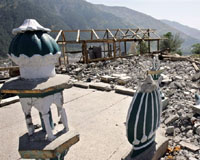
From bricks to wood and plastic sheets, anything goes in the reconstruction of earthquake-hit Balakot, despite official plans to move the entire city 30 kilometres (19 miles) to the south. "There's no question of moving from here," smiles Mohammed Ajmal, 50, whose New Punjab Clothes House is on the main road running through the centre of this destroyed northwestern Pakistani town.
"We were born here, we will die here," adds Massood Ahmad, 39, a pharmacist.
His customers agreed.
"Balakot is here, not at Bakrial," the site chosen by Pakistani authorities more than an hour's drive away for the building of the "New Balakot", says Mohammad Hanif, 30, a plumber from a nearby village.
Nearly 4,000 of Balakot's 30,000 inhabitants were killed by the earthquake of October 8, 2005. The town, the gateway to the Kaghan Valley tourist region, was just a few kilometres from the epicentre.
Almost every building was destroyed or seriously damaged by the 7.6-magnitude temblor. One year later, however, the bazaar has been almost totally rebuilt and work is still under way.
Heaps of brick, sand and gravel lie in the main street and wood piles block the alleyways. Brand new iron shop shutters keep out the low autumn sun in the afternoons.
Mohammad Tamassib, 36, sold furniture before the quake. Today he is doing well from a new trade — in corrugated iron sheets.
"People don't have enough money to by furniture — often they don't have a house to put it in anyway. But with corrugated iron business is good," he says.
Nearby in Medina Plaza, a well-built shopping mall which was one of the few buildings to withstand the quake's power "thanks to God, not thanks to the concrete", other shopkeepers now want to get on with rebuilding their homes.
All of them received an initial cheque of 25,000 rupees (416 dollars) from the government in January to get through the winter. Now they are waiting for their second installment, of 100,000 rupees, for rebuilding.
"But we are going to stay here. Our ancestors were born and died here and we will do the same," promise Tamassib and his colleagues.
At the other end of the town, in a tent which serves as his office, the nazim (mayor) of Balakot has a different opinion.
"They'll move," says Junaid Qasim.
"Let them say what they want. When they see what is being built for them, when they understand that they are not being evicted from Balakot and that we are offering in the New Balakot exactly what they had before, you'll see, they'll all come."
The centre of Balakot, which hugs the foaming River Kunhar, is situated directly on top of a seismic fault line and at the outlet of numerous flood-prone streams whose courses were disturbed by the quake's jolts.
"It's uninhabitable," says the mayor, adding that after the earthquake this summer's monsoon had caused fresh landslides and avalanches on loosened ground.
Several hundred people saw their houses swept away by the monsoon rains and had to move to tent camps that were originally set up for victims of the earthquake.
"More than one hundred million dollars will be invested, with the help of Saudi and Libyan finance, to create the new Balakot on its new site at Bakrial," halfway between Balakot and Mansehra, a major hub further south, explains Qasim.
"We are starting to rebuild the New Balakot. Come here in two or three years and you'll see, they'll all be there," he adds.
