
On Earth, gravity-driven south polar cap winds are termed "catabatic" winds. They are caused by the downward motion of cold air. Catabatic winds begin over the smooth expanse of the cap interior due to temperature differences between the atmosphere and the surface.
Once begun, the winds sweep outward along the surface of the polar cap toward the sea. As the polar surface slopes down toward sealevel, the wind speeds increase. Catabatic wind speeds in the Antarctic can reach several hundreds of miles per hour.
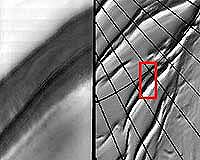
In the image of the Martian north polar cap we can see these same type of winds. Notice the streamers of dust moving downslope over the darker trough sides, these streamers show the laminar flow regime coming off the cap.
Within the trough one sees turbulent clouds of dust, kicked up at the trough base as the winds slow down and enter a chaotic flow regime. The horizontal lines in these images are due to framelet overlap and lighting conditions over the bright polar cap.
The dry valleys in Antarctica are a favorite spot for geologists and microbiologists to look for unusual terrestrial phenomenon. Mars itself is often compared to these low-humidity regions, the only continental part of Antarctica that is largely devoid of ice.
Despite the harsh conditions, plants and microbial life are not absent, a result that offers intriguing clues to adaptability of life on Earth.
2001 Mars
