
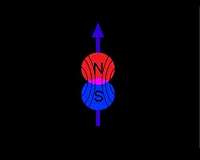
Current textbooks often refer to the Lorentz-Maxwell force governed by the electric charge. But they rarely refer to the extension of that theory required to explain the magnetic force on a point particle.
For elementary particles, such as muons or neutrinos, the magnetic force applied to such charges is unique and immutable. However, unlike the electric charge, the magnetic force strength is not quantised. For the magnetic force to act on them, the magnetic field has to be inhomogeneous. Hence this force is more difficult to understand in the context of particles whose speed is near the speed of light.
Moreover, our understanding of how a point-particle carrying a charge moves in presence of an inhomogenous magnetic field relied until now on two theories that were believed to differ. The first stems from William Gilbert's study of elementary magnetism in 16th century, while the second relies on Andre-Marie Ampere electric currents.
In a new study just published in EPJ C, the authors Johann Rafelski and colleagues from the University of Arizona, USA, succeeded in resolving this ambiguity between Ameperian and Gilbertian forms of magnetic force. Their solution makes it possible to characterise the interaction of particles whose speed is close to the speed of light in the presence of inhomogeneous electromagnetic fields.
In the new study, the authors present, for the first time, an important insight into how magnetic field non-homogeneity impacts particle spin dynamics, called spin precession. No prior work has recognised the need to make the form of magnetic torque consistent with the form of magnetic force – the torque was made consistent only with the Lorentz-Maxwell force.
This advance allows the impact of field non-homogeneity on precision experiment to be quantified. It seeks to resolve a discrepancy in the understanding of quantum field corrections to the magnetic moment of the muon, an elementary particle often referred to as a "heavy electron."
These findings can be applied to the study of neutrinos, opening the door to realms beyond the standard model of particle physics. Rafelski and colleagues show that the magnetic force can be large for particles whose speed is very close to the speed of light.
Astronomers detect 'whirlpool' movement in earliest galaxies
Astronomers have looked back to a time soon after the Big Bang, and have discovered swirling gas in some of the earliest galaxies to have formed in the universe. These 'newborns' – observed as they appeared nearly 13 billion years ago – spun like a whirlpool, similar to our own Milky Way. This is the first time that it has been possible to detect movement in galaxies at such an early point in th … read more
