
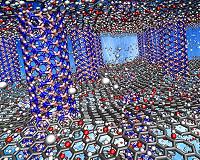
A team of scientists in Russia has developed a new material with promising hydrogen-storage abilities.
Hydrogen has been promised as the remedy for the world's addiction to fossil fuels. But to make hydrogen more economically viable, researchers must find cheaper, more efficient ways to make and store the gas.
Scientists at the Siberian Federal University have been working on the problem of hydrogen storage and distribution. New technologies and materials are needed to ensure hydrogen-powered vehicles have a place to fill up their tank.
Transporting hydrogen is dangerous, as air and hydrogen can react and combust. Researchers need materials that easily and efficiently absorb and store hydrogen so that it can be transported risk-free.
Magnesium has been identified as an ideal hydrogen-storing material. Theoretical models suggest magnesium can take up hydrogen at a rate of 7.6 percent of its mass. But until now, researchers have only been able to achieve absorption rates of between 5 and 6 percent.
Researchers were able to inch closer to magnesium's theoretical potential by adding nickel and palladium to magnesium hydride. The result was a material capable of absorbing roughly 7 percent of its weight in hydrogen.
Scientists described their success this week in the SibFU journal Mathematics and Physics.
"The most safe and effective solution now is hydride-forming metals that absorb hydrogen," researcher Grigoriy Churilov said in a news release. "Magnesium is the most promising of these metals: many scientists in the world are exploring the possibility of creating hydrogen accumulators based on magnesium hydride."
New device could turn heat energy into a viable fuel source
A new device being developed by Washington State University physicist Yi Gu could one day turn the heat generated by a wide array of electronics into a usable fuel source.
The device is a multicomponent, multilayered composite material called a van der Waals Schottky diode. It converts heat into electricity up to three times more efficiently than silicon – a semiconductor material widely u … read more
