
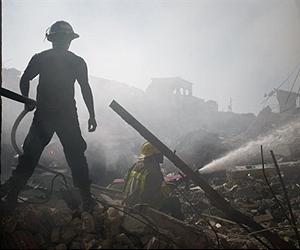
Even in death, poor Haitians have been forgotten, hauled off to mass graves after only the most cursory attempts are made at identifying them.
In the courtyard of what is left of the Caribbean Market, the largest supermarket in Port-au-Prince, trucks stopped and unloaded 30 workers in the broiling midday sun.
The site was thick with flies, and the stench of rotting flesh was everywhere.
The building's five floors collapsed like a house of cards when the powerful 7.0 magnitude earthquake struck on January 12, killing over 212,000 people and leaving an estimated one million homeless.
The workers spread five female bodies on the ground under a white sheet.
Meir Vaknin, who heads an excavation team the market owner hired and had been working since Saturday, said they had been unable to contact relatives of the people whose bodies were pulled out.
Just down the road, a strikingly different scene unfolded at the ruins of the luxury Hotel Montana, where dozens of mostly foreign guests died. There, the recovery of remains is a somber model of order and professionalism.
A list of the missing people is posted. Trucks busily shifted rubble and a backhoe digger carefully removed chunks of steel and concrete.
Visitors were separated from the hundreds of people who every day pick away at the rubble searching for bodies. They were also kept far enough away to not be bothered by the flies and smell of decomposing bodies.
"This is a very methodical search," said Danny Johnson, a US military spokesman. The US military manages teams of French, Canadian and Mexican rescuers at the site.
"We have observers. They are watching if they see bodies or remains," said Johnson. And if they do, he said, "they tell the truck driver with hand signals. Then, the body or remains go to a preparation area."
Once retrieved, the remains are moved to a US State Department mobile morgue set up in the city port. A team of US pathologists scrutinize the remains, identify them by first and last name, and return them to their families.
At the Caribbean Market, identification methods were more elementary.
"For the men, we have a wallet," said Vaknin, pointing to his rear pocket, sweat dripping from his forehead in the sweltering heat. "For the women, it's difficult: jewelry, shoes, earrings."
Fortunee Luna, 30, whose two aunts and sister were killed in the supermarket, had no doubts about what had happened to them.
"The bodies were already removed and they disappeared," she said.
Anyway, she sighed, sitting on the street in front of the reeking pile of rubble, "I have no money for a funeral ceremony."
In the first days after the earthquake, the government, in a panic, removed all unclaimed bodies.
Unless relatives had the means to recover them, the bodies were carted away in trucks and burned or dumped into mass graves.
"There has been no body identification from the beginning," said Lucile Grosjean, a spokeswoman for the aid group Action against Hunger.
Lacking a body, many families still hold out hope of finding their loved ones and have not begun the grieving process, she said.
Vaknin promised that bodies pulled out of the Caribbean Market would be handed over to relatives — but if nobody claimed them by the end of the working day, the local authorities would be contacted to dispose of them.
"In the Montana, there are a lot of foreigners, they have pressure from the embassies to find their people," said Vaknin.
"Here, there are ordinary people," he said. "These people cannot complain to anybody. As far as I know, there is no working government."
Share This Article With Planet Earth
