
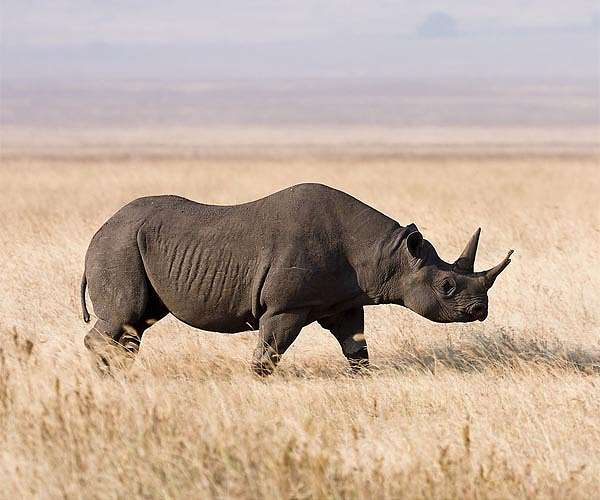
Moving home is stressful for anyone — and rhinoceroses are no exception.
Vets in South Africa have just transferred more than 30 orphaned young rhinos to a sanctuary designed to keep the animals safe from poachers who killed their mothers.
The move took six weeks and required extraordinary planning, including the help of animal friends who accompanied the orphans.
"We can't just move them all at the same time and go 'boom, there's a new home'," said Yolande van der Merwe, who oversees their new home.
"You have to take it on very carefully because they're sensitive animals," she said.
Van der Merwe, 40, manages the Rhino Orphanage, which cares for calves orphaned by poachers, rehabilitates them and then releases them back into the wild.
This month, after its old lease expired, the non-profit moved to bigger premises, in a secret location between game farms in the northern province of Limpopo.
Benji, a white calf who is only a few months old was the last rhino to relocate.
At birth, rhinos are small, not higher than an adult human knee, and tip the scales at around 20 kilogrammes (44 pounds).
But they eat a lot and quickly pick up weight, ballooning up to half a tonne in their first year of life.
Given Benji's recent loss, staff were worried he would freak out during the process that saw him anaesthetised and loaded in the back of a 4×4.
But thankfully Benji's friend, Button the sheep, was by his side throughout the move — and his presence helped ensure that everything went smoothly.
"Mostly, their mothers have been poached," said Pierre Bester, a 55-year-old veterinarian who has been involved with the orphanage since its founding 10 years ago.
"(They) all come here, and you handle them differently… you put them in creches, give them a friend and then they cope."
– 'Love and care' –
South Africa is home to nearly 80 percent of the world's rhinos.
But it is also a hotspot for rhino poaching, driven by demand from Asia, where horns are used in traditional medicine for their supposed therapeutic effect.
On the black market rhino horns fetch tens of thousands of dollars.
More than 450 rhinos were poached across South Africa in 2021, according to government figures.
At the sanctuary, orphaned calves are nursed back to health by a team of caregivers who sometimes pull 24-hour shifts, sleeping in the same enclosure as the animals to help them adjust.
"Rhinos have their calves at foot the whole day, 24/7, and that's the kind of care they require," said van der Merwe.
"So we need to give that intense love and care to get them through the trauma," she said, adding some younglings showed signs of post-traumatic-stress-disorder.
When they are fit enough, the animals are released back into the wild. Up to 90 percent normally make it.
At the new sanctuary, Benji and his friends enjoy bigger enclosures with more space to roam.
They are fitted special transmitters to monitor their movement as part of an array of security measures to keep poachers at bay.
The orphanage asked AFP's reporters not to disclose its new location.
"It is a war out there," Bester explained.
Monarch butterflies are now in 'red list' of endangered species
Washington DC (UPI) Jul 21, 2021 –
The migratory monarch butterfly fluttered its orange-and-black wings closer to extinction Thursday, joining for the first time an alarming "red list" of endangered creatures.
The dire classification by the International Union for the Conservation of Nature means the beloved insect's population has declined so dramatically, it is now only two steps away from vanishing entirely.
At greatest risk are the western monarch butterflies, whose numbers have plummeted by an estimated 99.9 percent since the 1980s, from 10 million to as few as 1,914 this year.
"It is difficult to watch monarch butterflies and their extraordinary migration teeter on the edge of collapse, but there are signs of hope," Anna Walker, who led IUCN's monarch butterfly assessment, said in a statement.
"So many people and organizations have come together to try and protect this butterfly and its habitats," said Walker, who works as a species survival officer at the New Mexico BioPark Society.
"From planting native milkweed and reducing pesticide use to supporting the protection of overwintering sites and contributing to community science, we all have a role to play in making sure this iconic insect makes a full recovery," she said.
Experts say monarchs are losing the fight for adequate shelter in Mexico and California, where their habitat continues to be destroyed to make way for logging, agriculture and urban development.
Pesticides and herbicides used in agriculture are also to blame, as they kill butterflies and milkweed, the only plant that larvae can eat.
Millions of butterflies have also been killed by severe weather and the rise of catastrophic wildfires and temperature extremes as climate change affects habitats where the insects live.
"It's been so sad to watch their numbers decline so much, so anything that might help them makes me happy, and I think that this designation might help them," UW-Madison Professor Karen Oberhauser told The New York Times.
"Although it's sad that they need that help, that they've reached the point where this designation is warranted."
IUCN Director General Bruno Oberle said there is much work to be done to change the current picture.
"To preserve the rich diversity of nature we need effective, fairly governed protected and conserved areas, alongside decisive action to tackle climate change and restore ecosystems," Oberle said in a statement. "In turn, conserving biodiversity supports communities by providing essential services such as food, water and sustainable jobs."
