
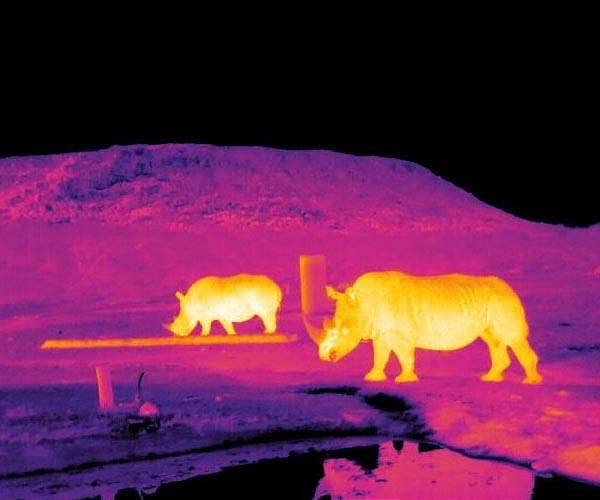
The number of rhinos killed in South Africa last year dropped by 33 percent, official figures showed Monday, partly helped by a coronavirus national lockdown which severely limited movement by poachers.
But the gains were marginally reversed when movement restrictions were loosened.
At least 394 rhinos were slaughtered in 2020, down from the 594 recorded the previous year, Environment Minister Barbara Creecy said in a statement.
Most of the rhinos — 245 — were killed in the Kruger National Park, a tourist magnet bordering Mozambique.
"During the Covid hard lockdown period we had a significant reduction in poacher incursions into the Kruger," said Creecy.
"However, that changed later in the year as the lockdown levels eased and a significant spike in poaching was experienced towards the end (of) 2020, especially during December."
South Africa, home to nearly 80 percent of the world's rhinos, has seen its poaching numbers steadily decrease for the sixth straight year.
But poachers, fuelled by a market for rhino horns in Asia, where they are used in traditional medicine or as a claimed aphrodisiac, have continued to mount an onslaught on the species.
Creecy said the decline in deaths should be celebrated as "a moderate win" but anti-poaching campaigns should not be relaxed, given the demand for horns.
Conservationists and opposition politicians say the latest figures ignore an overall decline in the rhinoceros population.
"For a number of years, there have been questions about what exactly is the population size of white and black rhinos," said Julian Rademeyer, director for East and Southern Africa at the Global Initiative Against Transnational Organised Crime.
"Ultimately, if there are fewer rhinos, they become a lot harder to find for poachers."
The World Wide Fund for Nature (WWF) said it had recorded an "almost 70 percent" decline in rhino numbers in the Kruger National Park over the last decade as a result of drought and poaching.
A report released last month by the national parks agency found there were only 3,549 white rhinos and 268 black rhinos left in the Kruger.
The country's largest opposition party, the Democratic Alliance, said the figures "paint a grim picture on the future survival" of rhinos in South Africa.
Human activity threatens species survival: study
Paris (AFP) Feb 1, 2021 –
Human activities such as farming and construction are threatening the survival of scores of wild species by forcing them to travel more to avoid mankind's impact, research showed Monday.
According to the United Nations' biodiversity panel, more than three quarters of land and 40 percent of Earth's oceans have already been "severely degraded" by humans.
Its landmark biodiversity assessment in 2019 drew on a large body of research into how human activities are impacting nature.
But there have been relatively few studies looking at specific species and how human influence is changing their behaviour.
Researchers in Australia looked at the impact of activities such as roads, tourism, recreation, hunting, shipping and fishing on 167 species, from the 0.05-gram sleepy orange butterfly to the two-tonne Great White shark.
They found that most species had increased the distance they travel due to human influence — by 70 percent on average.
In a third of species, movement had either increased or decreased by half, according to the study published in the journal Nature Ecology & Evolution.
"This tells us that humans have widespread impacts on animal movement, but in many cases these are going undetected and unaddressed," lead author Tim Doherty, from the University of Sydney, told AFP.
"In everyday life, we generally only see animals in the wild for short periods and don't get a proper understanding of how they move around and use space."
– 'Cascading impacts' –
Doherty said that since many species, including most mammals, spend nearly all their energy on hunting for food and finding mates, the additional energy required to relocate away from humans was an unwelcome survival challenge.
"However, animals will often move further in response to disturbance to ensure their survival, for example by seeking shelter, finding food," he said.
"Some species are able to cope with these changes better than others."
Of the taxonomic groups studied, birds and insects moved the most on average in order to avoid coming into contact with human activity.
The study warned of "cascading impacts" to natural processes such as pollination if such displacements continued apace.
The authors said they had documented a "global restructuring of animal movement, with potentially profound impacts on populations, species and ecosystem processes".
They called for better preservation of natural habitats through increasing protected areas and managing construction and tourism, as well as seasonal curbs on hunting during species' breeding periods.
