
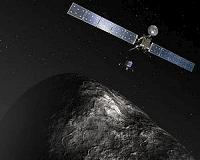
Following is a profile of the Rosetta spacecraft, its payload Philae and the instruments they carry:
ROSETTA
The backbone of the Rosetta mission is a large unmanned spacecraft designed to orbit 67P/Comet Churyumov-Gerasimenko as it races through the Solar System and scans its icy head with an array of hi-tech eyes.
This orbiter, Rosetta, is a 2.9-tonne box measuring 2.8 x 2.1 x 2.0 metres (9.1 x 6.8 X 6.5 feet) with two vast solar arrays, 14 metres (45 feet) long, which have the surface area of a basketball court.
The panels comprise hundreds of thousands of non-reflective silicon cells, enabling Rosetta to suck power out of sunlight even when the Sun, hundreds of millions of kilometres (miles) away, is just a cold and tiny disc.
Also revolutionary, for the age in which it was launched, is Rosetta's decision-making power.
Instructions from Earth, even though they are travelling at the speed of light, take up to 50 minutes to reach the spacecraft depending on its position, so Rosetta is equipped with smart computers, with backups to provide it with the "intelligence" to look after itself.
Rosetta's 11 instruments will grab images of the comet in various parts of the energy spectrum, analyse the gases that gush from its nucleus as its icy surface is stripped away by the Sun, and a powerful radar whose echoes should give a cross-section of the comet's nucleus.
The instruments are:
– Ultraviolet Imaging Spectrometer (ALICE)
– Comet Nucleus Sounding (CONSERT)
– Cometary Secondary Ion Mass Analyser (COSIMA)
– Grain Impact Analyser and Dust Accumulator (GIADA)
– Micro-Imaging Analysis System (MIDAS)
– Microwave Instrument for the Rosetta Orbiter (MIRO)
– Rosetta Orbiter Imaging System (OSIRIS)
– Rosetta Orbiter Spectrometer for Ion and Neutral Analysis (ROSINA)
– Rosetta Plasma Consortium (RPC)
– Radio Science Investigation (RSI)
– Visible and Infrared Mapping Spectrometer (VIRTIS)
PHILAE
Rosetta's payload is a miniaturised laboratory called Philae, which will carry out the first landing on a comet, using an onboard chemistry set to get a precise view of the elements that make its icy, rocky surface.
The 100-kilo (220 pound) lander, due to be released on November 11, will have to make a feathery landing to avoid bouncing back and spinning uselessly into space, for comets have very low gravity.
As soon it makes contact, it will fire a small tethered harpoon into the comet's surface to gain an anchorage, and then extend its three legs, whose feet will also drill down a few centimetres (inches) to get a good hold.
The lander's impact on the comet should not cause any deviation in trajectory, given the huge differences in their respective masses.
Philae will use its 10 instruments to analyse the chemical, mineralogical and radioactive composition of the comet's surface and subsurface.
This "hands-on" data will be relayed back to the orbiter, Rosetta, which will then retransmit the information to Earth.
Philae's instruments, and their mission names, are as follows:
– Alpha Proton X-ray Spectrometer (APXS)
– Rosetta Lander Imaging System (CIVA/ROLIS)
– Comet Nucleus Sounding (CONSERT)
– Cometary Sampling and Composition experiment (COSAC)
– Evolved Gas Analyser (PTOLEMY)
– Multi-Purpose Sensor for Surface and Subsurface Science (MUPUS)
– Rosetta Lander Imaging System, ROLIS, designed to provide the first close-up images of the landing site)
– RoLand Magnetometer and Plasma Monitor (ROMAP)
– Sample Distribution Device (SD2)
– Surface Electrical and Acoustic Monitoring Experiment, Dust Impact Monitor (SESAME)
NAMES
– Rosetta is named after the famous stone in the British Museum that helped early 19th-century Egyptologists decipher hieroglyphics, the script of the Pharoahs.
– Philae is named after an obelisk on the Nile whose inscriptions were in turn a key to the Rosetta Stone.
– Comet 67P/Churyumov-Gerasimenko is named after two Ukrainian astronomers, Klim Churyumov and Svetlana Gerasimenko, who first spotted it in 1969. The "67P" refers to its position on the International Astronomical Union (IAU) list of periodic comets, meaning comets whose return past Earth is known. 1P is occupied by the famous Halley's Comet.
– Rosetta was initially scheduled to launch in January 2003, but the launch was delayed for 14 months. Its initial target, 46P/Wirtanen, was replaced by Comet "C-G."
