
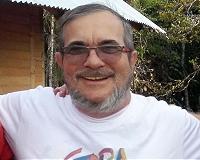
Colombian President Juan Manuel Santos and FARC guerrilla leader Timoleon "Timochenko" Jimenez come from different worlds: one a rich businessman and politician; the other a country boy turned communist guerrilla.
But the two former mortal enemies smiled and shook hands Monday after signing a historic peace deal to end a war they both spent much of their lives fighting.
Here are profiles of the conservative president and the Marxist guerrilla leader who brokered the end of half a century of conflict.
– Santos: fighter for peace –
Santos, 65, led a major offensive against the Revolutionary Armed Forces of Colombia (FARC) as defense minister from 2006 to 2009.
After becoming president in 2010, he shifted tack and negotiated for a settlement with the guerrillas.
"He made war as a means to achieve peace," said his brother-in-law and adviser, Mauricio Rodriguez.
"He weakened the FARC to make them sit at the negotiating table."
The peace drive "required courage, audacity, perseverance and a lot of strategy — those are Santos's strengths," Rodriguez added.
Despite fierce opposition to the talks from some former allies, Santos staked his presidency on the peace process.
"I am not looking for applause. I just want to do the right thing," he said.
He won reelection in 2014 in a vote widely seen as a referendum on the talks.
Santos is the scion of a wealthy, powerful family entrenched in Colombian politics and the media.
He has described himself as politically in the "extreme center."
He was educated at the London School of Economics and began his career as a journalist, covering the Sandinista revolution in Nicaragua as a young man.
He then switched to politics, serving in various ministerial posts.
– Timochenko: convict negotiator –
The bearded, bespectacled FARC leader's real name is Rodrigo Londono, but he is better known by his noms de guerre Timoleon Jimenez and Timochenko.
He was born to a Christian mother and a communist father in a coffee-growing region where he says he soon became aware of social injustice.
"At school, I wondered why there were some classmates who went without breakfast while others lived wastefully," he once said.
He has said the first book he read as a child was the Bible but he also read Karl Marx's "Communist Manifesto" by the age of 12.
State intelligence services say he received military and medical training in the Soviet Union and Cuba, which he denies.
"Eighty-five percent of what they say about me is lies," he once told Venezuelan TV network Telesur.
The stocky Timochenko, 57, is renowned as a strategist and former intelligence chief in the FARC, which battled state forces for decades in the jungle.
He has been convicted in absentia for various attacks for which he has been sentenced to more than 150 years in jail.
He took over as FARC leader in 2011 after his predecessor, Alfonso Cano, was killed by the army.
The following year, he wrote to Santos proposing fresh peace negotiations after efforts by previous leaders had failed.
He agreed to Santos's demand that the FARC end its campaign of kidnappings.
As a guerrilla he often said: "I prefer to die on my feet than live on my knees."
But in recent peace talks he softened his tone. At Monday's signing he apologized on behalf of the FARC to all the victims of the conflict.
Asked recently what he has learned in his career as a guerrilla, he said: "There shouldn't be wars."
"He is one of the most well-liked guys in the FARC," Ariel Avila, an analyst at Colombia's Peace and Reconciliation Foundation told AFP.
"He is the man who will go down in history for bringing the FARC into the peace process."
Timeline of the Colombia conflict
Cartagena, Colombia (AFP) Sept 27, 2016 –
After half a century of conflict, the Revolutionary Armed Forces of Colombia (FARC) and the country's government signed a full peace accord on Monday.
Here are key dates in Latin America's longest armed conflict, which has killed 260,000 people according to Colombian authorities.
– 1964: FARC formed –
The government launches an offensive against communist groups in the center and west of the country.
On May 27, rebel commander Manuel Marulanda Velez flees the assault with 47 other men and forms the FARC.
– 1984: First peace bid –
On March 28, conservative president Belisario Betancur launches peace talks with the FARC under a bilateral truce.
The initiative breaks down in 1987 after right-wing paramilitaries assassinate a presidential candidate from a party allied to the FARC. Further peace efforts collapse in 1991 and 2002.
– 1996: Hostages taken –
On August 30, the FARC takes 60 Colombian soldiers hostage at a military base in the south.
The raid marks the start of its strategy of mass hostage-takings, which dominates the conflict over the following years.
– 2000: 'Plan Colombia' –
In June, the United States and Colombian president Andres Pastrana launch "Plan Colombia," a joint anti-narcotics strategy.
It is later broadened to include anti-guerrilla operations. Washington has spent more than $10 billion on arming and training Colombian forces.
– 2002: Betancourt captured –
In February, the FARC kidnap Franco-Colombian politician Ingrid Betancourt, a candidate for Colombian president.
During more than six years captive in the jungle, she becomes an international symbol of the conflict. She is rescued by the military in 2008.
– 2011: FARC leader killed –
The FARC's top commander, Alfonso Cano, is killed in a raid by the Colombian army on November 4.
Two other top leaders, Raul Reyes and Jorge Briceno, were killed in 2008 and 2010.
Cano is replaced by current leader Timoleon Jimenez, who reaches out to the government for peace talks.
– 2012: New peace talks –
On October 4, President Juan Manuel Santos's government launches new peace talks with the FARC, weakened by the loss of its top leaders.
– 2016: Peace deal –
On June 23, the FARC and the government sign a definitive ceasefire and disarmament agreement, a precursor to a comprehensive peace deal.
On September 26, they sign the full peace accord. It will be put to a referendum for ratification on October 2.
