
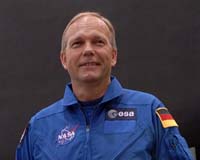
ESA astronaut Hans Schlegel of Germany has been named today to fly on the NASA space shuttle mission that will deliver the Europe's Columbus laboratory to the International Space Station in September or October 2007.
Jean-Jacques Dordain, ESA's director general, announced the assignment on the occasion of the German Chancellor Angela Merkel's official visit to ESA's Space Operations Center in Darmstadt, Germany. Veteran NASA space flier U.S. Navy Cmdr. Stephen Frick will command the STS-122 Shuttle mission (using shuttle Discovery), while Navy Cmdr. Alan Poindexter will serve as pilot.
Mission specialists will include Air Force Col. Rex Walheim, Stanley Love and Leland Melvin. For Poindexter, Love and Melvin, this will be their first spaceflight. Schlegel, a member of the European Astronaut Corps since 1998, first flew on STS-55 (Spacelab D-2) from April 26 to May 6, 1993.
On the mission, Schlegel will be involved in the installation, fitting-out and initial commissioning of the Columbus laboratory. Columbus is the cornerstone of Europe's contribution to the station and is the first European laboratory devoted to long-term research in space.
Columbus will be transported to the station in the shuttle's cargo bay together with five internal rack facilities (Biolab, the Fluid Science Laboratory, the European Physiology Modules facility, the European Drawer Rack and the European Transport Carrier).
The two external experiment facilities for Columbus (EuTEF and SOLAR) also will be traveling separately in the cargo bay and will be attached onto the outside of the laboratory module structure during Schlegel's flight.
Following the launch, from Kennedy Space Center in Florida, the shuttle will take two days to rendezvous and dock with the ISS. Columbus will be lifted out of the Shuttle's cargo bay by Canada's Space Station robotic arm (Canadarm 2) and placed in position on the starboard side docking port of the European-developed Node 2 on flight day four.
Once attached to the ISS, and following power-up of the module, the Columbus payload rack facilities will be moved from their launch configuration to their operational locations in the module.
Three spacewalks are scheduled for the mission. The first will help to install and power-up Columbus. A second EVA will serve to install the external payloads.
The payload rack facilities will also be checked out. The third EVA will serve to install a nitrogen tank assembly on the Station, a task not directly related to the Columbus part of the mission. Final commissioning of the laboratory and its initial scientific experiments will take place during the weeks following the end of the Shuttle mission and will be carried out by the resident ISS crew.
After Columbus is attached to the station, the Columbus Control Center in Oberpfaffenhofen, Germany – on the premises of DLR's space operations center, will be responsible for the control and operation of the European laboratory. The center also will coordinate European experiment operations.
