
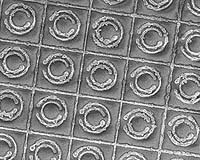
U.S. scientists have discovered thin films of "metamaterials" can reduce the size of resonating circuits that generate microwaves.
National Institute of Standards and Technology researchers said the use of metamaterials — man-made composites engineered to offer strange combinations of electromagnetic properties — is a step toward substantially shrinking the size of electronic devices such as cell phones, radios and radar equipment.
The researchers performed calculations and simulations of two-dimensional surface versions of so-called metafilms composed of metallic patches or dielectric pucks. Vibrating particles in the metafilms cause incoming electromagnetic energy to behave in unique ways.
The scientists deduced the effects of placing a metafilm across the inside center of a common type of resonator — a cavity in which microwaves continuously ricochet back and forth.
While other research groups have shown filling part of the cavity with bulk metamaterials allows resonators to shrink beyond the usual size limit, the NIST team said the same effect can be achieved with a single metafilm, which consumes less space, allowing for the possibility of smaller resonators and less energy loss.
The complex research appears in the journal Microwaves, Antennas & Propagation.
