
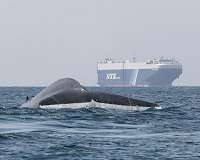
A new study has offered fresh insights into how whales are impacted by noise pollution.
Researchers at the University of Queensland in Australia wanted to find out if "ramp-up sequences" allow whales to acclimate to foreign noise. Ramp-up sequences describe the use of softer sounds for 10 to 20 minutes prior to the introduction of louder noise levels.
To find out, researchers subjected a pod of migrating humpback whales to a series of acoustic air guns, at different distances and decibel levels. The test results — detailed this week in the journal Marine Pollution Bulletin — suggest ramp-up sequences have no effect.
Whales avoid noise pollution, whether it is preceded by ramp-up sequences or not.
Air guns are frequently used by oil and gas drilling operations to map the ocean floor. Previous research has shown noise pollution to affect not just whales, but a variety of fish species, as well.
Conservation officials require oil and gas exploration outfits to employ buffer zones in an effort to protect whale migration routes. But during the recent tests, scientists found whales frequently rerouted themselves to put large distances between themselves and the air guns being trailed by the research vessel — distances considerably larger than standard mitigation requirements.
While the distance and decibel levels did have some effect on how quickly whales moved away from the research vessel and air guns, avoidance was the main content, suggesting noise pollution can easily disrupt whale migrational routes.
As a control, scientists followed whale pods in their research vessel without triggering the acoustic gun.
"Within a certain distance, they did not show a clear avoidance reaction to the vessel alone, suggesting it was the air guns that triggered this reaction," lead researcher Rebecca Dunlop said in a news release.
Canada orders reduced ship speeds to prevent right whale deaths
Canadian officials on Friday ordered boats including cargo and cruise ships to reduce their speed in the Gulf of Saint Lawrence in a bid to protect endangered whales.
The speed limit was capped at 10 knots (11.5 miles, 18.5 kilometers) per hour – about half the average current speeds – in areas where whales have been reported.
The move follows two months that saw an average of one Nort … read more
