
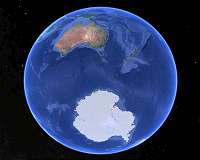
Scientists at The Australian National University (ANU) have produced the best estimate of Earth's elemental composition which will help them understand how the Earth formed 4.6 billion years ago.
The solar system began as a dense blob in a molecular cloud of hydrogen gas and dust that collapsed under its own gravity, forming the early Sun, Earth and other planets.
Co-researcher Associate Professor Charley Lineweaver said the Earth's chemical composition was set at that early stage of formation.
"The four most abundant elements – iron, oxygen, silicon and magnesium – make up more than 90 percent of the Earth's mass, but working out exactly what the Earth is made of is tricky," said Dr. Lineweaver from the Research School of Earth Sciences and the Research School of Astronomy and Astrophysics at ANU.
"Seismological studies of earthquakes inform us about the Earth's core, mantle and crust, but it's hard to convert this information into an elemental composition.
"Our deepest drilling has only scratched the surface down to 10 kilometres of our 6,400 kilometre radius planet. Rocks at the surface only come from as deep as the upper mantle."
The research is published in the international journal Icarus.
Lead author ANU PhD scholar Haiyang Wang said the team made the most comprehensive estimates of the Earth's composition based on a meta-analysis of previous estimates of the mantle and core, and a new estimate of the core's mass.
"Our work focused on getting realistic uncertainties so that our reference model can be used in future comparisons of the Earth with the Sun, or with Mars or with any other body in the solar system," said Mr. Wang from the ANU Research School of Astronomy and Astrophysics.
Co-researcher Professor Trevor Ireland from the ANU Research School of Earth Sciences said planetary scientists would find many uses for this new composition record.
"This will have far-reaching importance, not only for planetary bodies in our solar system but also other star systems in the universe," he said.
Sentinel-5P launch preparations in full swing
With liftoff set for 13 October, engineers at Russia's Plesetsk launch site are steaming ahead with the task of getting Europe's next Copernicus satellite ready for its journey into orbit.
The Sentinel-5P satellite has been at Plesetsk in northern Russia for almost two weeks. So far, it has been taken out of its transport container, positioned for testing and engineers have started ticking … read more
