
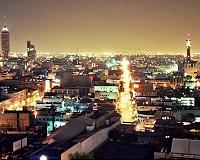
When the earthquake hit, it sent panicked people running into the street but many weren't so lucky. The dust settled minutes later to reveal a landscape of flattened buildings and rubble in the heart of Mexico City.
"Awful. I think it was one of the strongest we've felt. I don't know what magnitude, but it was awful," said Pedro Cruz Martinez, a public servant cradling his little girl, after joining the rush of fearful parents to a local school.
After the screams and the shock, people quickly set to work digging for survivors.
In a scene reproduced in streets across the city center, dozens of people scrabbled with bare hands to remove rubble from atop a concertinaed building as they waited for specialized machinery to arrive.
Central areas like Roma, Condesa and Doctores appeared to have taken the brunt of the 7.1-magnitude quake.
Several buildings were completely flattened in Roma, popular for its bars and restaurants and one of the neighborhoods hit hardest by the 1985 earthquake that shattered large swathes of this city and killed at least 10,000 — 32 years ago to the day.
Amid the tears and terror, there were small victories.
Cheers and applause echoed around the crowded Calle Alvaro Obregon in Roma as rescuers managed to pull someone from under the rubble.
There remained a sense that such moments would be rare, however.
In other buildings in the same area, volunteers joined the authorities to remove debris. One of them held a sign with the word "silence" in order to be able to hear people who may still be alive.
– 'Take care' –
Dozens of buildings collapsed in Mexico City — home to 20 million people — as the overall death stood at 216 early Wednesday in the capital city and across a swath of central states.
Authorities asked for help from volunteers and for water. Some police officers came through the crowd carrying containers of water.
Medics set up makeshift field hospitals in the streets, treating people for broken limbs and crush injuries.
Many people lay on stretchers, with medics holding strips of cardboard boxes over victims' heads to protect them from the sun.
"Darling, if you want to help, go ahead. Just give me your glasses and be careful," a woman told her doctor husband as they gazed at buildings reduced to rubble, the intimacy of people's homes laid bare as curtains swayed in buildings without walls.
Police called for calm and cordoned off streets with grotesquely twisted buildings, their reinforcing steel poking out from concrete.
People hugged and comforted each other amid anxiety about loved ones. Many stood around in a daze, not sure where to go or what to do.
But everyone was staying in the streets, afraid to go home.
Major earthquakes of the past 30 years
Hong Kong (AFP) Sept 20, 2017 –
A 7.1-magnitude earthquake has struck central Mexico, killing at least 140 people on the anniversary of a devastating 1985 quake.
Here are some of the most significant earthquakes of the last 30 years.
— Sept 7, 2017: A quake strikes the southern part of Mexico, killing 96 people. Seismological authorities measured the quake at 8.2, surpassing the 8.1-quake that killed 10,000 people in Mexico City in 1985.
— Jan 18, 2017 – Four earthquakes hit central Italy. About three hours later, an avalanche slams into a hotel on the eastern slopes of Monte Gran Sasso, burying the structure in rock and snow and killing 29 people.
— August 8, 2017: A relatively shallow 6.3-magnitude earthquake rattles northwest China, followed by two smaller aftershocks. Twenty-four people killed.
— August 24, 2016: A quake with a magnitude of up to 6.2 hits villages in central Italy, killing nearly 300 people. The tremor was felt in Rome, 150 kilometres (93 miles) from the epicentre near Amatrice.
— April 16, 2016: A 7.8-magnitude quake strikes Ecuador, killing 673 people and levelling thousands of buildings up and down the coast.
— February, 2016: A 6.4-magnitude quake hit Taiwan's Tainan. More than 100 people are killed after a building collapses.
— October 26, 2015: A powerful 7.5-magnitude quake strikes Afghanistan's Hindu Kush region and is felt through much of South Asia.
— April 25, 2015: A 7.8 magnitude quake in Nepal kills almost 8,900 people and destroys about half a million homes. A massive aftershock with a magnitude of 7.3 follows in May, killing dozens more.
— August 11, 2012: Twin earthquakes with magnitude 6.3 and 6.4 leave 306 dead and more than 3,000 injured near the Iranian city of Tabriz.
— March 11, 2011: Around 18,500 are killed when a tsunami triggered by a massive magnitude 9.1 undersea quake slams into the northeast coast of Japan, triggering a nuclear crisis at the Fukushima Daiichi atomic plant.
— October 23, 2011: An earthquake of 7.2 magnitude rocks eastern Turkey, leaving more than 600 dead and at least 4,150 injured.
— January 12, 2010: Magnitude 7.0 quake hits Haiti, leaving between 250,000 and 300,000 dead.
— April 14, 2010: A 6.9-magnitude quake hits Yushu county in northwest China's Qinghai province leaving 3,000 people dead and missing.
— May 12, 2008: A quake measuring 8.0 hits China's southwest province of Sichuan, leaving more than 87,000 people dead or missing.
— May 27, 2006: A powerful quake in Indonesia's Yogyakarta region kills 6,000 and leaves 1.5 million homeless.
— October 8, 2005: An earthquake of 7.6 magnitude kills more than 75,000 people, the vast majority of them in Pakistan's North West Frontier Province and the Pakistani-administered zone of Kashmir state. Some 3.5 million are displaced.
— March 28, 2005: An earthquake on Indonesia's Nias island off Sumatra leaves 900 dead.
— December 26, 2004: A magnitude 9.3 undersea earthquake off the coast of Sumatra triggers a tsunami that kills 220,000 in countries around the Indian Ocean, including 168,000 in Indonesia.
— December 26, 2003: A quake measuring 6.7 hits the Iranian city of Bam, killing at least 31,884 people and injuring 18,000.
— January 26, 2001: A massive 7.7 earthquake hits the western Indian state of Gujarat, killing 25,000 people and injuring 166,000.
— September 30, 1993: A 6.3-magnitude quake hits the western Indian state of Maharashtra, killing 7,601.
— October 20, 1991: A quake measuring 6.6 hits the Himalayan foothills of Uttar Pradesh state in India, killing 768.
— August 20, 1988: A magnitude 6.8 quake hits eastern Nepal, killing 721 people in Nepal and at least 277 in the neighbouring Indian state of Bihar.
2011 Tohoku-oki earthquake: Results from seismic reflection data
A striking finding of the 2011 Tohoku-oki earthquake (Mw 9.0) is that more than 50 meters of coseismic fault slip reached the trench axis. In addition to this, seismological studies found a clear depth-dependent variation in the source location between high- and low-frequency seismic energy radiation. However, structural features that may control the slip behavior in the rupture zone have not be … read more
