
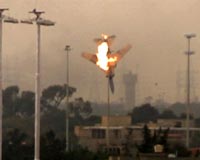
Congressional lawmakers on Capitol Hill will hear testimony at a hearing Tuesday at 3:30 p.m. from senior Defense Department officials and the principal engineer from NASA on physiological episodes occurring in military aircraft.
The House Armed Forces subcommittee on tactical air and land forces will hear from Lt. Gen. Mark Nowland, the deputy chief of staff of operations for the Air Force, along with Navy Physiological Events Action Team Lead Rear. Adm. Sara A. Joyner, and Clinton H. Cragg, who is the principal engineer at NASA's Engineering and Safety Center.
The hearing comes after growing concerns over "physiological episodes" occurring in T-45 Goshawks, a military jet-training aircraft manufactured by Boeing, and F/A-18 Super Hornets, as well as other assorted aircraft.
Reports on the topic have pointed to hypoxia being the root cause for the crashes. Hypoxia-related incidents occur when there is an inadequate amount of partial pressure of oxygen in the air.
Former Navy fighter pilot and F/A-18 standardization instructor and flight operations director Benjamin Kohlmann told UPI last year that hypoxia-related incidents were rare during his time in the Navy from 2004 to 2013, lamenting that the problem has only risen to prominence in the last few years.
"At a certain attitude, the concentration of air is insufficient to provide someone with human cognition," Kohlmann said. "The rule of thumb is that above 10,000 feet, prolonged exposure isn't going to give you enough oxygen to do the day-to-day things that you need to survive, so we rely heavily on those oxygen systems."
"I don't know what's causing it, maybe more attention is being paid to the issue, perhaps errors or mishaps that occurred in the past were not attributed to hypoxia-related incidents, but now are," Kohlmann said. "It's a mystery as to what the full extent of it is."
