
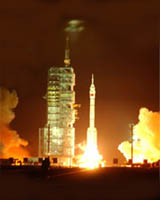
China early Monday successfully launched its fourth unmanned spacecraft, the "Shenzhou IV", from the Jiuquan Satellite Launch Center in northwest Gansu province, state media reported.
The official Xinhua news agency said the spacecraft was sent into a preset orbit by a "Long MarchII F" carrier rocket, which blasted off at 00:40 am (1640 GMT Sunday).
Space scientists at the Beijing Aerospace Command and Control Center said the "Shenzhou IV" successfully entered its preset orbit.
Su Shuangning, commander and leading designer of the astronaut system for China's manned space program, said Chinese astronauts, all of whom were airforce fighter pilots, had entered the spacecraft to receive training for the first time.
The launch of the "Shenzhou IV," or "Divine Vessel IV" is considered the latest dress rehearsal for China's eventual launch of a manned spacecraft.
Gu Yidong, commander and chief designer of the space application system, said a number of scientific experiments would be conducted while the spacecraft remained in space, including some involving the astronaut flight system, control of the spacecraft environment and life support sub-system.
While it remains decades behind the United States and Russia in space technology, the Chinese Communist Party appears to view putting an astronaut amongst the stars as an important prestige project. The launch came during a visit to China by German Chancellor Gerhard Schroeder.
In May, official Chinese media said a longer-term aim of China's fiercely ambitious space program was to establish a base on the moon in order to exploit its mineral resources.
Compared with the previous three unmanned space capsules launched between 1999 and March this year, Shenzhou IV "represents China's most sophisticated and fullest preparations to finalizing its goal of manned space flights," official media quoted Chinese Aerospace Science and Technology Corp. president Zhang Qingwei as saying last month.
earlier related report
This Weekend
The Hong Kong newspaper Wen Wei Po reported Saturday that the Shenzhou-4 mission would be launched this weekend. Based on past experience on the previous three Shenzhou missions the launch is expected to take place at night to aid optical tracking.
Although the weather remains frigid across China, a fleet of three ocean going tracking ships are in place and ready for what is expected to be the final test launch before Beijing puts its first man in space.
The choice of a night launch window was primarily for ease of optical tracking. Ground-based tracking cameras could follow the brilliant rocket exhaust much easier at night than a daytime launch.
Leaders of the Central Committee of the Party will be at the Jiuquan Satellite Launch Centre (JSLC), which is in the northwestern Gansu Province, to witness the launch.
Weather at JSLC and surrounding area is favourable but very cold.
The fleet of four Yuanwang (YW, Yuanwang means "Long View") tracking vessels had long left port to sail towards their respective positions to support tracking activities for the mission.
Unnamed Chinese space officials told the newspaper that a successful SZ-4 mission would pave the way for the historic manned spaceflight on SZ-5.
SZ-4 will circle the Earth 108 times in a 7-day primary mission. Its operational circular orbit will be 343 km high, the same as that of the SZ-3 primary mission.
At least one, possibly two, mannequins — or "analogue human" as Chinese space officials refer to — will ride on SZ-4.
The analogue human simulates human metabolism, physiological signs and physique.
One of the objectives of sending analogue human on the unmanned Shenzhou test missions is to evaluate the environment control and life support systems on the spacecraft.
To ensure the safety of the yuhangyuans ("astronauts") on a Shenzhou mission, the Changzheng-2F (CZ-2F or Long March 2F) launcher is equipped with an emergency escape tower and a fault monitoring and detection system.
Wen Wei Po said that there would be even more reliable safety measure implemented for the SZ-4 mission. However, details of the new measure were not available.
It is expected that the emergency escape tower would be tested once again after the first in-flight deployment test during the launch of SZ-3.
The newspaper also reported that the ground search and rescue system would be available on this flight.
According to the newspaper, the twelve yuhangyuan trainees will be at the launch centre to practise emergency bailout from the spacecraft at the launch pad.
Chinese media widely reported after the launch of SZ-3 that the 12 yuhangyuan trainees were at JSLC to see the blastoff and practise emergency escape on the pad.
Earlier this month Chinese scientists
