
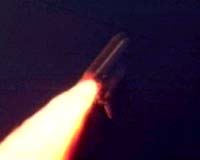
Space , particularly upon blastoff and in the final moments of their missions.
This was clearly demonstrated when Challenger exploded after launch on January 28, 1986, and when Columbia disintegrated upon reentry into the Earth's atmosphere on February 1, 2003.
The launch is the most critical phase, as the shuttle goes from zero to almost 29,000 kilometers per hour in just over eight minutes.
The failure of an O-ring seal in one of Challenger's solid rocket boosters created a leak that caused the shuttle to explode 73 seconds after launch, killing all seven crew members.
Since the 1986 disaster, NASA has faced several close calls, all of them at liftoff.
In October 2002, four explosive bolts that release the space shuttle upon launch failed to operate, but four backup bolts took over, enabling the shuttle, whose engines had already ignited, to blast off.
In March 2002, it was Columbia that experienced problems minutes after launch, when a critical Freon cooling system lost pressure during the shuttle's ascent into orbit. NASA initially considered an emergency return to Earth but eventually decided a backup line would adequately cool the spacecraft's electronics.
When Discovery took off in late 1999, turbine blades within a metal alloy pump cut a groove into a seal, threatening the integrity of the engine.
In July 1999, a short-circuit during Columbia's liftoff shut down two of the three computers that control the main engine nozzles.
Even the 2003 Columbia tragedy that killed seven astronauts was blamed on a problem at launch, when a piece of insulating foam detached itself from the external tank and hit the orbiter's left wing 82 seconds after liftoff.
The impact created a crack that let hot gas penetrate the spaceship during reentry into the Earth's atmosphere, causing the orbiter's internal structure to disintegrate.
