
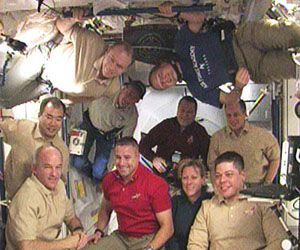
The US space shuttle Endeavour linked up with the orbiting International Space Station Wednesday, as the two vessels opened their hatches and brought together 11 space voyagers.
Before docking, Endeavour Commander George Zamka maneuvered the shuttle into a back flip over the space station, a move captured in high resolution images that will be scrutinized for signs of damage to the shuttle's delicate heat shield.
The two craft were flying 225 miles (362 kilometers) off the northern coast of Spain when they docked at 0506 GMT, nearly two days after blasting off from the Kennedy Space Center in Florida.
Zamka backed the space shuttle "into pressurized mating adapter number 2 on the International Space Station's Harmony node," said NASA, which broadcast the maneuver live on NASA TV.
The shuttle and station crews opened hatches at 0716 GMT, welcoming each other as the conjoined space ships orbited over Australia.
"With the arrival of Endeavour's six astronauts, the station's population grows to 11 and its mass tops one million pounds," NASA said.
After resting, the crew members will transfer supplies to the space station, prepare for space walks and make repairs.
Their most important tasks begin Thursday with a first spacewalk and the installation of a seven-windowed dome observation deck on the ISS that will provide spectacular panoramic views of Earth and space.
Built for NASA by the European group Thales Alenia Space in their Turin factory, the cupola will help crew members monitor space walks and docking operations.
It can accommodate two crew members at a time, and is equipped with portable workstations that can control station and robotic activities.
Six windows are arrayed along its sides and another on top — all protected against the impact of tiny meteorites.
Installing the Tranquility module will require a team of two astronauts to undertake three spacewalks lasting six and a half hours each.
Once the new room is in place, the space station will be 90 percent complete.
The mission, one of five scheduled for NASA's three shuttles before the program ends later this year after a 29-year run, comes as the US space agency reevaluates its future after President Barack Obama effectively abandoned its plan to send astronauts back to the moon by 2020.
Constrained by soaring deficits, Obama submitted a budget to Congress that encourages NASA to focus instead on developing commercial transport alternatives to ferry astronauts to the ISS after the shuttle program ends.
The ISS, a joint project involving 16 countries, has cost around 100 billion dollars, mostly funded by the United States.
Under Obama's new budget, the floating research station could see its life extended by five years until 2020.
Share This Article With Planet Earth
