
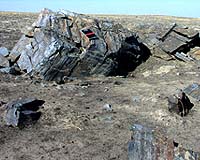
Geologists have uncovered a scene in the Pasco Basin west of the Columbia River that shows how boulders piggybacked icebergs from what is now Montana and came to rest at elevations as high as 1,200 feet.
Although glacial deposits of rocks and boulders are common, especially in the upper Midwest, "There probably isn't anyplace else in the world where there are so many rocks that rafted in on icebergs," said Bruce Bjornstad, a geologist at the Department of Energy's Pacific Northwest National Laboratory in Richland, Wash.
The rocks were left after ice dams holding back a huge lake near Missoula, Mont., broke, re-formed and broke again from 1 million to 2 million years ago to as recently as 13,000 years ago. The floodwaters backed up at the downstream end of the Pasco Basin behind Wallula Gap, a narrow ridge opening through which the Columbia River flows today.
The lake lapped the gentle slope of Rattlesnake Mountain, northwest of the gap and part of the Hanford Reach National Monument in south-central Washington Rattlesnake Mountain was the highest peak protruding from the 800-foot-deep temporary body of water, dubbed Lake Lewis. The rocks and boulders, so-called erratics, grounded as the waters of Lake Lewis receded after a few days like a slowly draining bathtub.
— Bergmounds and larger rocks were carried by large icebergs and were generally deposited below 1,000 feet.
