
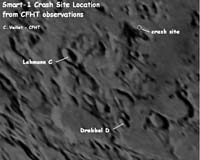
Timing, location, detection of a flash and of ejected material, and a firework generated by the lunar impact of ESA's SMART-1, are the latest results gathered thanks to the ground observation campaign of this historical event.
"The successful capture of the SMART-1 impact from Earth raised a substantial interest in the amateur and professional astronomical community. They started to reanalyse the available data, to repeat observations of the impact site and to share the results worldwide as a family", says Pascale Ehrenfreund, coordinator of the SMART-1 impact ground observation campaign.
Where did SMART-1 impact the Moon?
"From the various observations and models, we try to reconstruct the 'movie' of what happened to the spacecraft and to the Moon surface," says ESA SMART-1 Project scientist Bernard Foing. "For this lunar 'Crash Scene Investigation', we need all possible Earth witnesses and observational facts."
The actual SMART-1 impact took place on 3 September 2006 in the course of the spacecraft's 2890th orbit around the Moon. SMART-1 sent its last signals to Earth at 07:42:21:759 CEST (05:42:21:759 UT), and the JIVE radio telescope from Hobart, Tasmania, measured a loss of signal a few moments later, at 07:42:22.394 CEST (05:42:22.394 UT).
These times are remarkably in agreement with the last SMART-1 flight dynamics predictions of 3 September at 07:42:20 CEST (05:42:20 UT), in the location at 46.20 West longitude and 34.4 South latitude.
This is also in agreement with the coordinates newly derived from the position of the infrared impact flash observed by the Canada-France-Hawaii telescope (CFHT).
Extensive data processing is now going on to specify the topography of the impact site.
From a preliminary analysis of the topographic stereo data available and earlier maps built with SMART-1 data, the satellite should have hit the Moon in the ascending slope of a mountain about 1.5 kilometres high, above the Lake of Excellence plain.
What happened? Dust after the flash
