
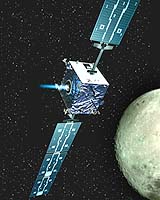
After more than 32 hours of accumulated thrust, the SMART-1 electric propulsion system (EPS), with a SNECMA PPS-1350-G Hall-Effect thruster, is now fully tuned for nominal operations under space conditions.
The thruster performance and discharge stability are very good and confirmed by the measurements of total spacecraft acceleration over an orbit. As planned, the EPS commissioning had started during the fourth orbit with a venting sequence of the xenon subsystem in order to eliminate any presence of water vapour and oxygen.
Then a first firing sequence of 50 minutes was completed successfully with the nominal cathode followed by a 6 minutes sequence at full power on the redundant one.
This sequence was interrupted by discharge flame out after the thruster had remained in a high oscillation mode. After a complete electrical check of the system, the thruster was fired successfully on the primary cathode for 2.5 hours.
The ion drive
