
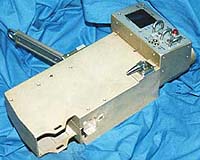
The world's smallest high-performance mass spectrometer, newly delivered to the International Space Station, may play a critical role in detecting leaks outside the orbiting facility.
Delivered last week to the space station by Space Shuttle Atlantis, the instrument will be available in the airlock for use by astronauts during their spacewalks. The device was specifically designed for use outside the space station. It can detect ammonia, rocket propellant, oxygen, nitrogen and water leaks.
"The instrument will promote spaceflight safety for the International Space Station," said Dr. Ara Chutjian of NASA's Jet Propulsion Laboratory, Pasadena, Calif. Chutjian is the principal investigator on the instrument, called the quadrupole mass spectrometer array.
The mass spectrometer, about 5 centimeters long (about 2 inches), is part of a shoebox-sized system with software and visual readout called the trace gas analyzer, developed in collaboration with NASA's Johnson Space Center and subcontractor Oceaneering Space Systems, both in Houston.
The whole unit weighs about 2.3 kilograms (5 pounds) and can be placed on an astronaut's chest pack, where it can easily point toward the areas under inspection. A small screen displays a graph that reports the detection of specific gases and their amounts, indicating to the astronauts a potential safety risk.
"JPL has developed the smallest mass spectrometer ever produced for either manned or robotic spaceflight," said Chutjian.
"On missions to Mars and beyond, where commodities will be at a premium, miniaturizing devices while maintaining their performance is crucial to mission success.
"We feel the device is very versatile and envision it being used in a cabin or airlock both for long-duration human flight missions and for planetary on-site life detection."
The instrument can detect ammonia coolant leaks that may arise from the many quick-disconnect fittings on the U.S. laboratory module Destiny. Cooling is required to maintain a uniform temperature as the space station travels through the temperature extremes of direct sunlight and shadow.
On Saturday, February 10, during the first spacewalk, an obvious leak occurred while astronauts installed the coolant ammonia lines to the Destiny module.
The trace gas analyzer was not used because the leak was obvious, but the instrument will remain on the space station for future use. JPL scientists were on standby for consulting with NASA during all three spacewalks.
The present generation of quadrupole mass spectrometers being flown on the
