
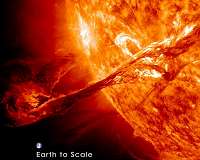
New research shows solar storms leave large portions of Earth's atmosphere without electrons.
Typically, when a solar storm reaches Earth, the collision with the planet's magnetosphere creates space through which a barrage of charged particles and electrons flood the ionosphere, an outer layer of Earth's atmosphere.
In other words, solar storms are most often associated with an excess of electrons. However, the new findings — detailed in the journal Radio Science — prove electrons disappear from large parts of the atmosphere at the same time that they congregate elsewhere.
"We made extensive measurements in connection with a specific solar storm over the Arctic in 2014, and here we found that electrons in large quantities are virtually vacuum-cleaned from areas extending over 500 to 1,000 kilometers," Per Hoeg, a professor at the Technical University of Denmark, explained in a news release. "It takes place just south of an area with heavy increases in electron density, known as patches."
Currently, scientists only know that the phenomenon happened, not why it happened, but there is plenty of data to survey for clues. Satellites and geomagnetic measuring stations operated by DTU recorded a multitude of data related to the 2014 storm.
The main goal of Per Hoeg and his colleagues at DTU is to better understand how electromagnetic storms affect communications and navigation systems, but the researchers hope their continued analysis of electromagnetic data will further illuminate the phenomenon of missing electrons.
"There are two aspects of this research. It can both be used for a number of practical purposes, and then there is a theoretical part which is about achieving a better basic understanding of these phenomena," said Tibor Durgonics, a doctoral student at DTU Space.
"Our new research has enabled us to identify a number of critical factors that affect the quality of satellite-based navigation, and to assess the probability of when these factors may occur," Durgonics continued. "At a more theoretical level, we have found out that during solar storms, electrons are removed in the ionosphere, which is the opposite of what you intuitively would expect."
First Solar Images from NOAA's GOES-16 Satellite
The first images from the Solar Ultraviolet Imager or SUVI instrument aboard NOAA's GOES-16 satellite have been successful, capturing a large coronal hole on Jan. 29, 2017. The sun's 11-year activity cycle is currently approaching solar minimum, and during this time powerful solar flares become scarce and coronal holes become the primary space weather phenomena – this one in particular initiated … read more
