
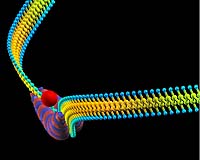
U.S. scientists say they've discovered exotic particles called solitons — short for "solitary waves" — have intricate internal structures. Since the 1980s, researchers have known solitons can carry an electrical charge when traveling through certain organic polymers.
But with the new information from Ohio State University researchers, scientists say solitons may be put to work in molecular electronics and artificial muscles.
Ju Li, an Ohio State assistant professor of materials science and engineering, says each soliton consists of an electron surrounded by other particles called phonons. Just as a photon is a particle of light energy, a phonon is a particle of vibrational energy.
The Ohio State study suggests the electron inside a soliton can attain different energy states, just as the electron in a hydrogen atom.
Li said the solitons' quantum mechanical properties are important because they affect how the particle carries a charge through organic materials such as conducting polymers at the molecular level.
"These extra electronic states will have an effect — we just don't know right now if it will be for better or worse," he said.
Li and Massachusetts Institute of Technology colleagues recently published their findings in the Proceedings of the National Academy of Sciences.
