
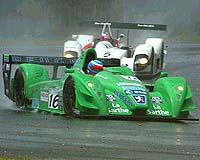
Pescarolo car no. 18 came 4th in this year's 24-hour Le Mans race, thanks to three excellent drivers and a car optimised with advanced technology originally designed for European space programmes.
"The car was pretty good this year. We were fighting for the podium and were really close right from the beginning – we were second, then third and ended fourth. The race was very exciting and we managed not to make too many mistakes," said Soheil Ayari, one of the drivers of the 900 kg Pescarolo-Judd C 60 prototype racing car ¿ a car with almost 600-horsepower under its bonnet.
It is now two years since ESA's Technology Transfer Programme (TTP) began cooperating with Henri Pescarolo and his sports team to provide space technology for their racing cars. The priorities given were security, reliability and performance and advanced space technology from European space technology has helped to improve the car¿s safety, and reduce weight and drag.
"Without ESA and its technology transfer programme we would not have known what is available and what can be adapted for our use. From space we now use high-stress composites for the body to reduce the weight and protect against heat," said Andr¿ de Cortanze, Technical Director of Pescarolo Sport. In fact, composite materials designed for space have helped the team reduce the car¿s body weight by an amazing 38 kg.
¿Heat protection is essential,¿ Andr¿ de Cortanze explained, "it not only improves safety but it also helps the car to run. The engine produces a lot of heat and the car cannot run with so much heat. We need to add lots of insulation and this is much easier to do with the products developed for space."
Space technology is also present in the car¿s wheel bearings as they have a special hybrid construction that uses stainless steel rings with ceramic balls. This spin-off from satellite gyroscopes is now used in high-precision machinery.
Space technology for cars
