
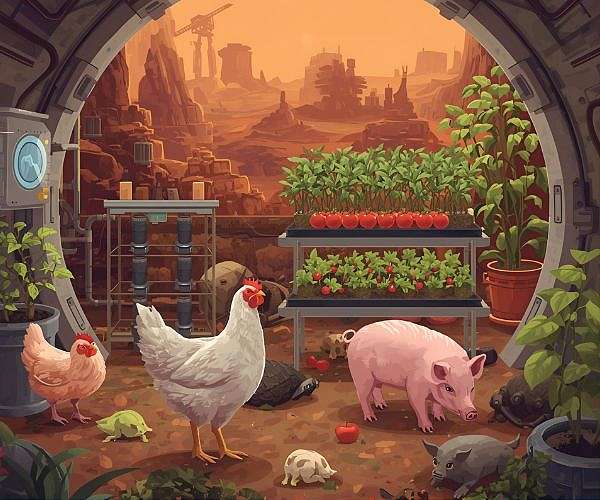
When it comes to colonizing Mars, most people imagine glass domes, rovers, red dust and endless wastelands. But there is one much more down-to-earth – or rather, "earthly" – topic that will test future colonists: food. And while bold experiments are already being conducted with plants on the Red Planet, the question of growing animals remains almost unanswered. Is it possible to build a real space farm on Mars?
Why this idea seems fantastic
The atmosphere of Mars is 100 times thinner than Earth's, the temperature rarely rises above -50C, and the radiation level is 2.5 times higher than on Earth. For animals, this is an almost lethal set of conditions. Even people with their technology will live under domes or under the surface, not to mention cows, chickens or, say, cats.
And yet, the idea of animals in Martian colonies does not arise without reason. Humans are creatures of habit. We not only eat meat, milk, and eggs, but also live next to animals – for the sake of company, psychological comfort, and even scientific research. Therefore, the talk about "Martian farms" is not a joke, but a very real discussion in scientific circles.
Which animals could theoretically "fly first"
Given the limitations, future "Martian farms" are unlikely to start with cows or sheep. It is much more likely that at first we will talk about:
+ insects – a source of protein, unpretentiousness, and minimal requirements for conditions;
+ fish and shrimp in aquaponic systems;
+ chickens as relatively "universal" suppliers of protein and eggs;
+ rodents for scientific experiments and adaptation studies.
Pigs or cattle are a much more distant prospect. They require colossal amounts of resources and space, which Mars will clearly not have in the first decades.
Plants versus animals: biology is relentless
Today, many researchers are inclined to believe that the first generations of colonists will depend almost entirely on plant proteins. And this is logical: plants are easier to grow in closed biospheres. However, completely abandoning animal products is a difficult task. Protein, vitamins of group B12, fatty acids – all this is easier to get through meat or at least animal products.
Therefore, humanity faces a dilemma: to rely on artificial meat and bioreactors or to try to create living farms. The second option is more difficult, but it provides something that no biotech printer can provide – an emotional and cultural connection between humans and animals.
The ethical and psychological side
Here the conversation becomes even more interesting. Imagine you live on Mars. Red rocks outside the window, endless dust, a strict regime and a feeling of constant danger. An animal nearby is not only a source of food, but also a way to preserve humanity.
Psychologists from NASA have already noted that animals on the ISS could reduce the stress level of astronauts, but for obvious reasons this is not yet practiced. On Mars, everything will be different: missions are long, people are cut off from Earth. And a cat purring in the corner of the module may be more important than it seems.
Here it is appropriate to recall the modern research of DNA test for cats. It would seem, what does Mars have to do with it? But it is precisely these technologies that help to understand the genetics of domestic animals, their predisposition to diseases, and nutritional characteristics. In the conditions of a Martian colony, knowledge of the "strengths" and "weaknesses" of a particular breed can literally become a matter of survival. After all, there may not be a veterinarian at hand, and the animal's genetic passport will help predict and prevent problems.
First steps: what has already been done
Although there are, of course, no animals on Mars yet, experiments on Earth are in full swing.
+ In Japan, they have developed projects for "space aquaponic systems" where fish and plants coexist in a closed cycle.
+ Chinese researchers conducted experiments with silkworms on orbital stations back in 2019.
+ NASA tested the effect of microgravity on fruit flies, which helps to understand how animals reproduce outside of Earth.
All these experiments do not provide a direct answer to the question "how to start a cow on Mars", but they gradually fit together into a mosaic that could one day lead us to full-fledged Martian farms.
The future: reality or fantasy?
If we look at the coming decades, the development of synthetic meat seems more likely. Already today, companies like Upside Foods or Mosa Meat grow muscle tissue in laboratories. On Mars, such technology could save a lot of resources.
However, in the long term – when the planet has cities under domes and the population grows to tens of thousands – animals may well return to everyday life. Then there will be farms, veterinarians, and even "Martian shelters".
Future Paths
Talking about animals on Mars is not about feeding colonists bacon. It is about preserving human culture, habits and emotional stability. After all, a farm is not only a source of food, it is also a connection with the Earth, its history and way of life.
Will the first Martian settlers have a cow? Most likely not. A cat or a chicken? Maybe. But the idea of space farms is no longer science fiction, but a challenge of the near future. And how we respond to it will determine what life will be like for people far from our blue planet.
