
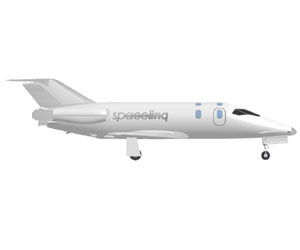
Dutch initiative SpaceLinq announces that it will operate as Europe's first spaceflight operator from within Holland's territory. Lelystad Airport is the proposed home base for the future EU Spaceport Lelystad, as long as all regulation and approval from the government and Airport partners will be granted. It also requires investigating planning, environmental and safety issues.
"Nonetheless, we are very excited about the opportunities to service the EU spaceflight market from Lelystad", says Chuck Lauer, US co-founder of SpaceLinq.
"We choose Lelystad for its location next to the sea and close proximity to the North Sea military reserve airspace. Besides, the open space and available land, plus the desire of the community to encourage new technology and industry are other reasons to choose Lelystad as SpaceLinq`s domicile.
"Also important to choose Holland is the fact that the European spaceflight market may be the largest in the world, and the Amsterdam region is already one of the greatest tourist destinations on the planet."
Flights can be expected to take place as soon as June, 2015.
Space: the next commercial frontier
The changing landscape of the space arena is giving birth to privately funded initiatives around the globe. SpaceLinq NV, Europe's first spaceliner to propose operating spaceflights from within European airspace, has chosen the Lelystad Airport as its future base for flight operations. With a unique mission profile and vehicle architecture, SpaceLinq is able to launch and re-enter the atmosphere from almost every standard, commercial airport.
The privatization trend in the US is catching on in Europe and other regions. With new government cutbacks being announced daily, the focus and demand of spaceflight services has shifted to the private sector market. SpaceLinq will provide short and long-term benefits to the scientific community as well as the tourist and payload markets.
By selling flights to the nearby Dutch and German space organizations, SpaceLinq will capture the market demand for less expensive and more frequent opportunities for microgravity research, astronomy, climate research, and small satellite launch.
The European Space Agency is also interested in the potential use for commercial suborbital vehicles for microgravity research, Earth observation and remote sensing applications, astronomy, and small satellite launch. SpaceLinq submitted its plans for suborbital flight services to ESA under its Request for Information solicitation in February.
The SpaceLinq spaceliner vehicle will seat one pilot plus five customers when flying space tourism flights. For research purposes the four rear seats are removed and replaced with experiment racks or other payloads, while leaving the front right seat in place for payload operators or researchers to fly and operate their experiments.
The spaceplane will use turbojet engines for takeoff and landing and a liquid oxygen / kerosene main rocket engine to power the ascent to space and over three minutes of weightlessness as the vehicle coasts up to the 100 km+ peak altitude and back. Its technical development has brought the design to a level of maturity that reassures investor confidence to see the vehicle through, all the way to the final testing stage.
"We are very excited about the opportunities to service the EU spaceflight market from Lelystad" says Chuck Lauer, the US co-founder of SpaceLinq.
"We choose Lelystad for its location next to the sea and close proximity to the North Sea military reserve airspace. Besides, the open space and available land, plus the desire of the community to encourage new technology and industry are other reasons to choose Lelystad as SpaceLinq`s domicile.
"Also important to choose Holland is the fact that the European spaceflight market may be the largest in the world, and the Amsterdam region is already one of the greatest tourist destinations on the planet, with great hotels, museums, fine dining and numerous cultural events and attractions. Combining this incredible base of existing Five Star tourism infrastructure with the new opportunities for exciting and breathtakingly beautiful commercial spaceflight will be a winning formula."
Share This Article With Planet Earth
