
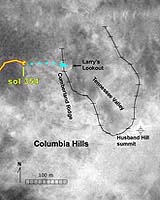
With one eye on the weather, Spirit continued work on "Husband Hill," making detailed observations of a rock called "Champagne," using the full suite of instruments.
Engineers continue to have difficulty getting the rover to make significant progress toward a ridgeline destination due to high slippage that Spirit experiences on the sandy, sloped terrain. Spirit has been in roughly the same spot for the past 30 sols.
Since temporarily getting a potato-sized rock caught in the right rear wheel on sol 339, engineers have been careful to monitor the slip as Spirit drives. If the wheels slip too much, engineers stop the drive to avoid the possibility of picking up another rock as Spirit spins and digs with its wheels.
The opacity of the sky – or how much light does not shine through the atmosphere – has been higher than normal in the past week due to local dust disturbances.
Higher opacity means less energy for the solar-powered rover. However, despite the recent increase in opacity, Spirit has had adequate energy (with a safe margin) to continue normal operations.
The rover's power bus return is a collection of wires designed to carry current back to the rover power source (battery or solar array). Electrical current between Spirit's chassis and the power bus return changed on sol 342 from zero volts to 0.1 volts.
The small change in voltage coincided with powering of heater circuits on the instrument deployment device (or rover arm). This confirms that there is a short (unexpected metal-to-metal contact) between the power bus return and the chassis, as had been suspected since October.
The short is somewhere on the return side of the rover arm heater circuits. The presence of this short does not affect daily operations. It does, however, take away one layer of protection should Spirit have a short to the chassis somewhere else on Spirit.
Sol Summaries:
