
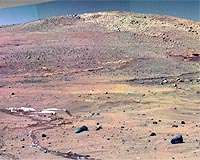
NASA mission controllers report that Spirit continues to be productive even as Martian winter conditions harshen. Controllers at Jet Propulsion Laboratory report that Spirit now receives about one-third as much solar energy as the rover received during the Martian summer while it explored Husband Hill, in the Columbia Hills of Gusev Crater.
The rover now receives about 310 watt-hours per Martian day, or sol, compared with 900 watt-hours per sol last summer. A hundred watt-hours is the amount of electricity needed to light one 100-watt bulb for one hour.
The power supply limits how much work Spirit can do each sol. Nevertheless, Spirit acquired two more columns of the 360-degree McMurdo panorama it has been acquiring, plus a mosaic of microscopic images of a third layer of soil in a target known as Progress 3.
In addition, Spirit has completed six targeted studies using the miniature thermal emission spectrometer, all while the rover was also communicating with the Odyssey spacecraft during its overhead pass.
The rover team is preparing to send new flight software, known as version R9.2, to Spirit. Two previous flight-software upgrades were sent solely via Spirit's high-gain, X-band antenna, but the new uplink plan calls for using both X-band and UHF antennas.
X-band communications between NASA's Deep Space Network and Spirit often are unavailable, because NASA also has been using that frequency to support the Mars Reconnaissance Orbiter during its aerobraking around the planet.
