
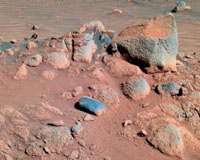
Spirit is healthy and power positive. Spirit is doing some remarkable science at "Larry's Outcrop," moving along the edge of this spot that looks stereotypically Mars-like.
As Spirit drives from place to place, the rover reaches out with its robotic arm and samples rocks.
According to MER Prinicpal Investigator, Steve Squyres, progress at been very satisfying. "We're starting to understand this place. What we've got is a thick sequence of layered rocks, dipping gently to the northwest. As you go up and down the sequence, there is a remarkable diversity of textures."
In his online diary, Squyres writes, "some rocks, like Watchtower, which we saw at Larry's Lookout quite awhile ago, are massive. Others, like Keystone at Methuselah, are finely laminated.
"Still others, like Keel at Jibsheet and like a new one called Ahab that we've just found on the eastern side of Larry's Lookout, have an unusual bulbous or globular texture. So texturally, the rocks in this sequence are all over the map.
"Despite the huge diversity in texture, though, all of these rocks have the same chemical composition. Every single rock we've looked at in this region shows a distinctive chemical "fingerprint" of high titanium, high phosphorous, and low chromium. They're all fundamentally made of the same stuff.
"But then, despite the constant chemistry, the rocks show an enormous range in how severely they have been altered. Alteration is something we can assess with our Moessbauer spectrometer, and the Moessbauer spectra of these rocks are incredibly diverse.
"Keystone, for example, is only lightly altered, with plenty of the mineral pyroxene in it. Paros, on the other hand (which, like Ahab, is on the eastern side of Larry's Lookout) is one of the most heavily altered rocks we've ever seen at Gusev. And some of the most-altered rocks contain the mineral goethite, which is a clear sign that their alteration involved water.
"So what are we dealing with here? Our best bet is that this is a stack of "volcaniclastic" rocks… granular rocks of volcanic origin. Some of the rocks may have formed by violent eruptions, followed by ashfall from the sky or hot, ground-hugging flows.
"Others may have formed when volcanic deposits were "reworked" by other processes, stirred up and redeposited. The very constant chemistry suggests that all the layers in the stack came from a common volcanic source.
"We're still working out some of the implications of the alteration. Is the alteration greatest at the bottom of the stack and least at the top, indicating a decrease in alteration processes with time? Or does the alteration also vary laterally, with rocks of the same age that are only tens of meters apart showing very different amounts of alteration?
"This is the piece of the puzzle that we're still struggling with, taking lots of Moessbauer measurements and trying to work out stratigraphic relationships between rocks in different outcrops. It's an important question, because it's related to what the water was doing.
"And I wouldn't say that we're 100% convinced yet that these are volcaniclastic rocks. While it seems like the best explanation, we haven't ruled out the possibility that they could have been formed by impacts. Impacts are violent explosions too, and impacts certainly were happening on Mars billions of years ago when these rocks formed.
"These don't look anything like impact deposits on the Moon, but Mars has an atmosphere, and back when these rocks formed it may have had a more substantial one. So it's possible that martian impact deposits could look like this too. We're keeping our minds open to the possibility, and looking for clues that might settle it definitively.
"Finally, an interesting side note. If some of the rocks are highly altered and some lightly altered, but they all have the same amount of phosporous in them, that suggests that the phosphorous was primary.
"In other words, the phosphorous was in the rock before any alteration took place, not put there by the alteration. When we first saw this high phosphorous signature, all the way back at Wishstone five or six months ago, our initial suspicion was that it was in phosphate salts that had been deposited by water. But it's looking now like this stuff was phosphorous-rich from the git-go," reports Squyres.
Sol-by-sol summaries
