
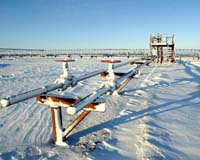
For an hour, the helicopter flew over a frozen wasteland where gas flares were the only sign of human life, before landing in a swirl of snow on a deserted track. A few hundred meters away lay the giant Vyngayakhinsk gas deposit run by Russian behemoth Gazprom in a corner of western Siberia where temperatures fall to minus 60 degrees Celsius in deep winter.
In early November, however, the conditions were not so bad. "Pressure 773 mm, Moisture 82 percent, Temperature -24 C," read a digital display panel at the entrance of a shiny new building.
The 350 people who work here are now bracing for more extreme conditions, when an icy wind sweeps these plains located close to the Arctic Circle.
"In winter, the workers wear special clothing with a hood and a mask which covers the entire face, apart from the eyes," explained site director Alexander Sorokin.
His pride and joy are ultramodern installations to "dry" gas of its water content and increase its pressure in the pipeline — part of Gazprom's efforts to show it has caught up with Western rivals and can guarantee supplies.
Under strict supervision by security guards, a group of journalists invited to Vyngayakhinsk were not allowed to visit the older installations that belch out clouds of smoke on the horizon.
The shift workers are on duty for seven days in a row, eleven hours per day, before taking a bus along more than 200 kilometers (124 miles) of ice-covered road to the city of Noyabrsk for a week of rest.
Ukrainians, Tatars and Russians are attracted to this hostile corner of Siberia by enticing wages, far higher than the country's average of around 300 dollars (233 euros) per month.
"People earn on average 40,000 rubles (1,600 dollars, 1,170 euros) per month," Sorokin said.
Close to Vyngayakhinsk, Gazprom Neft, Gazprom's rapidly expanding oil subsidiary, drills in search of the black gold that also abounds in Siberia. "Before you lived in old wooden carriages where one froze in winter. Now, everything is more comfortable," said Vladimir Dovgalov, a drilling engineer, standing on top of a rickety rig stained by oil.
"You have electric radiators, a sauna, a canteen. But the mosquitoes will always be there in summer!"
The helicopter set off again for a village populated by the Nenets people indigenous to Russia's Far North, who survive on fishing and hunting.
Gazprom, which has been accused of encroaching on their ancestral lands, proudly showed off its social assistance projects.
A boarding school where the children of the tundra live has been renovated and the locals have all received snowmobiles.
Brick constructions in the village have replaced old wooden homes and traditional Chum reindeer-skin tents.
"We try to safeguard the way of life of the indigenous population while creating more civilized conditions," said Valery Minlikayev, the assistant general manager of Gazprom subsidiary Noyabrskgazdobycha.
But Yasha Kozimkin, a reindeer herder and father of eight children, who lives in the village, did not sound impressed by Gazprom's largesse.
"Gazprom, that doesn't interest me. Here, there is work, you can fish. And the winter, so what? We survive!" he said.
"At minus 25 degrees, the weather is not cold."
