
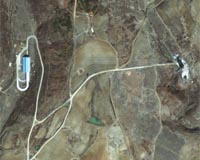
Spy satellites have photographed the nose cone of a long-range North Korean rocket on its launch pad, South Korea's main news agency said Sunday, with tensions high ahead of what the US says will be an illegal missile test.
Global concern has been mounting over North Korea's announcement that it will launch a communications satellite between April 4 and 8.
The United States, Japan and South Korea believe Pyongyang is actually testing a Taepodong-2 missile that could, in theory, reach Alaska.
"Spy satellites spotted the upper part of the rocket had its coverings removed on the launch pad," an unnamed South Korean government source told Seoul's Yonhap news agency.
"But it is impossible to tell what object has been loaded onto the round-shaped (rocket) top — a satellite or a warhead."
South Korea's defence ministry declined to comment on the report.
Seoul believes Pyongyang will choose its launch date based on weather considerations, Yonhap said.
The North's launch site is expected to have either snow or rain in the afternoon on April 4, cloudy skies on April 5 and clear skies from April 6 to 10, Yonhap said quoting Seoul's Meteorological Agency.
Japan's Sankei Shimbun newspaper said Sunday a group of Iranian missile experts was staying in North Korea to help Pyongyang prepare for the launch.
The 15-strong Iranian delegation, including senior officials with Iranian rocket and satellite producer Shahid Hemmat Industrial Group, has been in the North since the beginning of March, Sankei said, quoting unnamed sources.
The delegation brought a letter from Iranian President Mahmoud Ahmadinejad to North Korean leader Kim Jong-Il stressing the importance of cooperating on space technology, it added.
A top US general last week said the United States could shoot down the projectile if it was determined to be a ballistic missile, and Japan also said it would try to shoot down any rocket heading for its territory.
South Korea, Japan and the United States have warned that North Korea's rocket launch would be in violation of a UN Security Council resolution banning the communist state from carrying out ballistic missile activities.
The envoys from the three allies met in Washington during the weekend to discuss countermeasures to be taken against North Korea.
Pyongyang has resisted pressure to call off the launch and warned that any attempt to shoot down the rocket would be regarded as an act of war.
Washington and Tokyo have worked jointly on a missile defence shield, using land and sea-based missiles, against a possible attack from North Korea, which fired a missile over Japan in 1998 and tested a nuclear bomb in 2006.
US National Intelligence Director Dennis Blair said last week North Korea wanted to show it was capable of launching an intercontinental ballistic missile.
Share This Article With Planet Earth
