
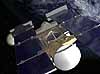
JPL universe – Jan 20, 1998 – Stardust, the "faster, better, cheaper" Discovery Program mission that will send a spacecraft to gather a sample from a comet, has met the milestones necessary to begin assembly and test of the spacecraft hardware and software in early January at Lockheed Martin Astronautics in Denver.
Scheduled for launch in February 1999, the Stardust
spacecraft will embark on a seven-year journey through the coma
and to within about 150 kilometers of the nucleus of Comet Wild-
2 (pronounced "VILT-2). It will be the first space mission to
gather dust and other material from a comet and bring it back to
Earth for scientific analysis.
Stardust's scientific bounty from its five-year voyage will
also include samples of the interstellar dust that passes
through the solar system. Return of this interstellar material
will provide scientists with their first opportunity for
laboratory study of the composition of the interstellar medium.
"We've experienced good cost and schedule performance in
1997," said Stardust Project Manager Dr. Kenneth Atkins. "We've
learned lessons from previous Discovery projects like Mars
Pathfinder, and we've been working to leverage common
efficiencies with the other Mars projects being worked by JPL
and Lockheed Martin." The project finalized its designs in June
and has completed and collected almost all the hardware and
software components in preparation for the system assembly and
test, Atkins said.
In February, Stardust mission engineers from JPL and Lockheed
Martin will convene for a parachute drop test for the Stardust
sample return reentry capsule system on the snowy desert plateau
of the Utah Test and Training Range near Salt Lake City. The
test range is the scheduled delivery site for Stardust's sample
return in January 2006.
Comet Wild-2 is a 'fresh' comet that was recently (in 1974)
deflected by Jupiter's gravity from an earlier orbit lying much
farther out in the solar system. Having spent most of the last
4.6 billion years in the coldest, most distant reaches of the
solar system, Wild-2 represents a well-preserved example of the
fundamental building blocks out of which the solar system
formed.
Both the comet and interstellar dust samples will be
collected in aerogel, a lightweight transparent silica gel, the
lowest density solid material in the world. (Aerogel was most
recently used as a lightweight insulating material to protect
the Mars Pathfinder Sojourner's electronics from the harsh, cold
climate of Mars.)
In November, the project received tens of thousands of
responses to its invitation to the public to "send your name to
a comet." JPL's Microdevices Lab will etch the names on a
silicon wafer that will be placed on the Stardust reentry
capsule. The names, collected in partnership with The Planetary
Society, will make a round trip to Comet Wild 2, returning to
Earth in the sample return capsule.
