
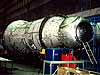
The International Space Station will complete a major milestone toward its first launch as the first station piece, a U.S.-funded and Russian-built control module, is shipped from a Moscow factory next week to its Russian Space Agency launch site in Baikonur, Kazahkstan.
In advance of the shipment of the control module, formerly
called the Functional Cargo Block and designated by the Russian
acronym FGB, a rollout ceremony and press conference will be
held at the Khrunichev State Research and Production Center in
Moscow at 11 a.m. Moscow time on Saturday, Jan. 17. Highlights
of the rollout ceremony will be broadcast, tape-delayed, on
NASA Television at 3 p.m. EST Saturday, with a repeat airing at
6 p.m. EST. The actual shipping of the control module is
scheduled to begin on Thursday, Jan. 22.
The 20-ton module is targeted for a late June launch to
begin the five-year, 45-flight orbital assembly of the new
space station. It will be launched on a Russian Proton rocket
from the Baikonur Cosmodrome in Kazahkstan. The control module
was built by the Khrunichev factory, under contract to The
Boeing Company, the prime contractor to NASA for the
International Space Station. It will depart Khrunichev via a
special rail car late next week to begin the 1,200-mile, five-
day train journey to Baikonur, where it will begin five months
of launch preparations and final testing.
"When the control module arrives at Baikonur, all of the
elements for our first two launches will be undergoing final
launch processing," International Space Station program manager
Randy Brinkley said. "The year of the International Space
Station is 1998. This is something that all of us have looked
forward to for a very long time. We have a lot of exciting and
challenging activities ahead as we begin our assembly in orbit.
The incredible efforts of a worldwide engineering and
development team will be coming to fruition, and a new,
unprecedented phase of space construction will begin."
Shortly after the control module is launched from Russia,
Endeavour will launch on Space Shuttle mission STS-88 from the
Kennedy Space Center, FL, with the second piece of the station,
a connecting module called Node-1, built by Boeing at NASA's
Marshall Space Flight Center, Huntsville, AL.
The node was shipped to Kennedy to begin a year of launch preparations and
final testing in June 1997. Two mating adpaters have since been shipped to Kennedy from California and are being attached to the node prior to its launch. Endeavour's crew will dock the control module to the node and perform three spacewalks to make final connections between the two components during the 11-day flight.
The station will then await the launch of the
Russian-built Service Module, a component that will become the
early living quarters, targeted for December. The first crew
of the new station is planned for launch on a mission in early
1999.
The 20-ton control module will provide early power and
propulsion for the station as well as the capability to
remotely rendezvous and dock with the Service Module.
Construction began on the control module at Khrunichev in
December 1994.
