
A Stratasys customer brought the future one step closer with a recent rapid manufacturing application. When a belt-sander-pulley failure halted production in the customer's finishing area, the company rapid manufactured a replacement unit from polycarbonate on a Stratasys FDM Titan(TM) prototyping system. Instead of waiting days for an aluminum replacement part, the company designed and built its own replacement in under four hours.
"I had a model of the pulley drawn up in CAD (computer aided design) in less than an hour," says Kirk Moswen, the manufacturer's fabrication manager. "Then we built the part from polycarbonate on the Titan rapid prototyping system; It took only 2 or 3 hours to build it.
"Although we have many sanders throughout the shop, most of them are continuously used. I didn't have to make the decision to pull a sander away from a less-critical production line. I was able to keep right on going. It's been a month now and the belt sander is still going strong."
This application is probably the first in which a rapid manufacturing process produced an actual replacement part on-the-spot for working production equipment.
The event occurred at one of the several customer beta-test sites commissioned by Stratasys to help fine-tune the Titan before its release. The beta site chose to remain unnamed.
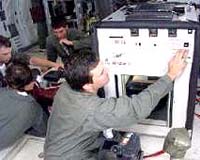
While a humble pulley helps usher in an era of rapid manufacturing on earth, NASA engineers hope to use rapid manufacturing on a grander scale — on the International Space Station or in space travel.
Astronauts can't carry every spare part they might need, so the space administration may eventually use rapid prototyping systems to manufacturer parts in space. NASA has experimented with Stratasys rapid prototyping systems with good results.
A white paper describing the results is available on the
