
If you've ever had a cold preventing you from really tasting your food, you've experienced what astronauts aboard the International Space Station encounter at every meal. In a reduced-gravity environment, the fluids in astronauts' bodies shift around equally, filling up their faces, feeling similar to the congestion from a cold, reducing their ability to smell, and ultimately dulling their sense of taste.
But hope is on the way for these taste bud-challenged explorers. Several thousand middle and high school students from Miami-Dade County in Florida are on the case. For the past two years, plant researchers at NASA's Kennedy Space Center have been partnering with Fairchild Tropical Botanic Garden in Miami to create STEM-based challenges for teachers and students in the area. There are two challenges-Growing Beyond Earth and Green Cuisine: The Flavor of Space Travel.
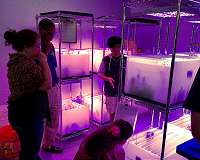
Over this past school year, the students participated in Growing Beyond Earth by growing crops in mini botany labs provided to each of the participating schools by Fairchild.
Each lab mimics NASA's Veggie plant growth system currently aboard the space station, and the students had to follow research protocols set forth by NASA and Fairchild while testing factors that could influence plant growth, flavor and nutrition-all so they can help NASA pick the next crops to grow for the astronauts aboard the station.
"The Veggie team at KSC is excited to be working with Fairchild Tropical Botanic Garden and middle and high schools groups to help us identify future varieties and best growing practices for use on the International Space Station," said Dr.
Gioia Massa, Veggie project scientist. "We plan to use the data from the student research to help us determine what to grow and how to grow it in Veggie experiments in the future."
The second challenge came on Saturday, March 4, where the student-scientists presented flavorful culinary dishes astronauts could eat in space as part of the Green Cuisine challenge.
Students were asked to create dishes with fresh herbs and spices to add variety and flavor to astronauts' daily meals. Students had to research the origins of the chosen herbs and spices, how they are grown and prepared, and the nutritional value of both the herbs and spices and the prepared dish.
One judge, Charlie Quincy, a NASA research advisor in food production, said, "High-quality foods with fresh strong flavors will give astronauts both what they need and what they want during their long exploration missions."
KSC Education's Theresa Martinez, who manages the four-year NASA Institutional Engagement Fairchild grant from Kennedy's Education Office, is excited for the south Florida student participants. "Eventually, they'll see direct results of their research when astronauts on the ISS try veggies they, in part, helped grow."
During the challenge, the students posted regular updates of their work on Twitter. You can follow their space farming @fairchdchallnge.
In addition to Veggie, a large plant growth chamber called the Advanced Plant Habitat is on its way to the space station-increasing the amount of scientific knowledge needed to dig deeper into long-duration food production for missions farther and farther from home.
3D Pizza Printer to Feed Hungry Astronauts in Deep Space
Has this ever happened to you? You're drifting through the vacuum of space, millions of miles from Earth, when suddenly you have a craving for pizza. To satisfy this probable demand, a startup has raised $1 million in seed funding to create a 3D printer that they hope can be used as a spaceship's pizza oven.
The company, BeeHex, intends to build "3D printing robots that prepare food faster … read more
